
How PSU Transfers Quietly Reshape Personal Relationships
How PSU Transfers Quietly Reshape Personal Relationships
Jan 27, 2026

Stable jobs often demand unstable personal rhythms.
A reflective look at how PSU systems influence family and personal bonds over time.
Introduction.
A career in a Public Sector Undertaking (PSU) is often associated with stability, respect, and long-term security.
For many professionals, it represents reliability in an uncertain employment landscape. Salaries arrive on time. The organisation endures. The system feels dependable.
Yet beneath this structural stability lies a quieter reality—one that rarely appears in official discussions or performance reviews.
PSU careers, especially those involving regular transfers and postings, subtly reshape personal relationships over time.
Not through conflict.
Not through failure.
But through gradual distance.
This article is not about advice or solutions. It is about awareness—about recognising patterns that quietly emerge within PSU life.
The Nature of Transfers in PSU Careers.
Transfers are an integral part of many PSU roles. They are often designed to ensure operational efficiency, regional balance, and institutional continuity.
From an organisational perspective, transfers make sense.
From a personal perspective, they require constant adjustment.
Each transfer resets routines. Familiar neighbourhoods change.
Social circles dissolve and reform. Family members adapt—again and again.
Over time, these repeated transitions begin to affect the emotional rhythm of personal relationships.
Early Career: Flexibility and Adjustment.

In the early years of a PSU career, relationships tend to feel more flexible.
Energy is high.
Expectations are open.
Change feels manageable.
Transfers are often seen as temporary disruptions. Families adjust with optimism. The belief is simple:
“Once things settle, balance will return.”
During this phase, emotional costs exist, but they are often overlooked. There is momentum, and momentum masks strain.
Mid-Career: Repetition with Weight.
As careers progress, the same patterns continue—but with added responsibility.
Children are older and need presence, not just provision.
Parents may require support and consistency.
Spouses carry long-term responsibilities, often in silence.
Internally, many PSU employees repeat familiar thoughts:
“After the next posting.”
“Once this phase passes.”
“When things stabilise.”
Yet stability keeps shifting forward.
What changes is not commitment, but availability.
When Presence Reduces.
Most PSU relationships do not deteriorate through arguments or visible conflict.
They change through reduced presence.
Conversations become functional.
Time together becomes scheduled.
Emotional closeness turns procedural.
Nothing dramatic breaks.
Everything simply becomes quieter.
This is not neglect. It is not a lack of care.
It is responsibility stretching across too many roles.
The Silent Nature of Emotional Distance.
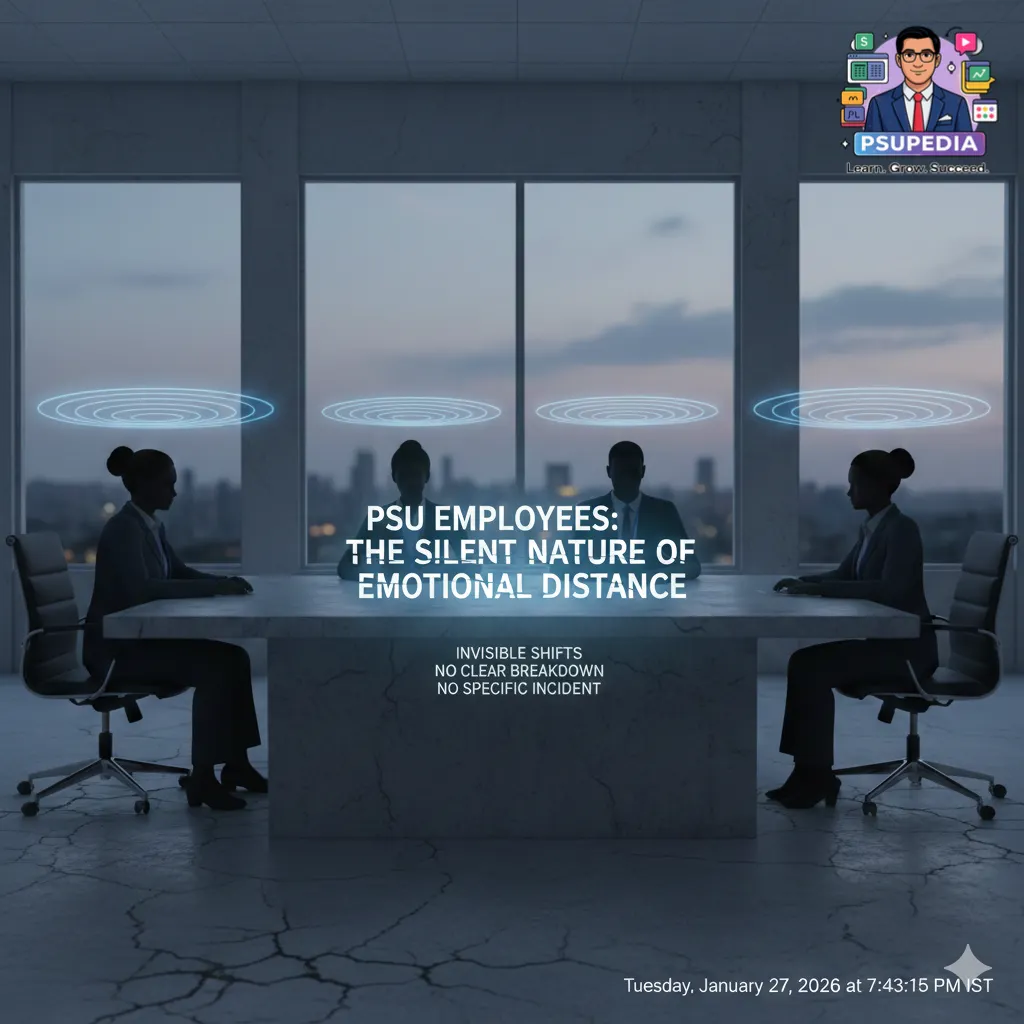
One of the most challenging aspects of relationship changes in PSU life is their invisibility.
There is often no clear moment of breakdown.
No specific incident to point to.
No argument to resolve.
Instead, there is silence.
Silence that feels normal.
Silence that becomes routine.
Silence that goes unquestioned.
Many employees only recognise this distance much later—when emotional withdrawal feels familiar rather than alarming.
Why This Often Goes Unspoken.
PSU professionals rarely speak openly about relationship strain because it feels contradictory.
The job is secure.
The income is stable.
The position is respected.
Acknowledging discomfort can feel ungrateful.
As a result, emotional pressure is internalised. Responsibilities are fulfilled. Rolesare performed. The system continues to function.
Quietly.
Awareness Before Drift Becomes Habit.
Recognising these patterns is not about guilt.
It is about awareness.
Awareness allows individuals to name experiences before they harden into habits. It creates space to notice what often goes unnoticed.
Personal relationships in PSU life rarely collapse suddenly.
They fade gradually—unless noticed.
Closing Reflection.
A stable career does not automatically create stable personal rhythms.
PSU systems are designed for institutional continuity. Personal relationships operate on emotional presence.
When these two move at different speeds for too long, distance appears.
Not as conflict.
Not as failure.
But as quiet adjustment.
In the next reflection, we will explore how professional relationships within PSU systems shape daily work life and personal wellbeing.
A Note from the Founder.
I am Ramjee Meena, Founder of PSUPEDIA.
Over years of working closely with PSU employees,
I have seen how silent financial stress builds —
not because of poor income,
but because of delayed clarity.
PSUPEDIA exists to surface such realities calmly and honestly.
Not to judge.
Not to rush.
Only to help you see clearly.
Because clarity is not pressure.
It is relief.
Nothing is wrong with you.
You are just becoming more aware.