
Is Declining Energy Inevitable for PSU Employees After 10–20 Years of Service?
Is Declining Energy Inevitable for PSU Employees After 10–20 Years of Service?
Mar 27, 2026

In PSU life, long-term stability often becomes a defining feature of professional identity.
Roles become familiar.
Work environments become predictable.
Responsibilities become structured.
Over time, routine develops a rhythm.
And within this rhythm, many PSU employees quietly begin noticing a subtle shift in physical energy.
Nothing sudden.
Nothing alarming.
Just a gradual difference compared to earlier years.
Morning freshness may feel slightly reduced.
Long working days may require more recovery.
Physical effort may feel slightly heavier than before.
Externally, everything continues normally.
But internally, the body sometimes responds differently.
Many employees assume this is simply a result of age.
And often, the thought stops there.
However, PSU work environments also influence lifestyle structure over long durations.
Daily schedules become consistent.
Work patterns become system-oriented.
Administrative responsibilities increase.
Movement during working hours gradually reduces.
Over years, these small patterns accumulate.
Not in a dramatic way.
But in a measurable way.
Early Years of PSU Life.
In the initial years of service, professional life involves adjustment.
Transfers require relocation.
Learning new systems requires mental engagement.
New colleagues require social adaptation.
Daily routine involves variation.
Movement happens naturally.
Walking across departments.
Handling operational activities.
Adapting to new environments.
Energy often feels stable because daily life includes physical and mental variation.
Variation stimulates alertness.
Alertness supports engagement.
Engagement supports energy.
At this stage, physical vitality is rarely noticed consciously.
Because it feels normal.
Mid-Service Stability Phase.
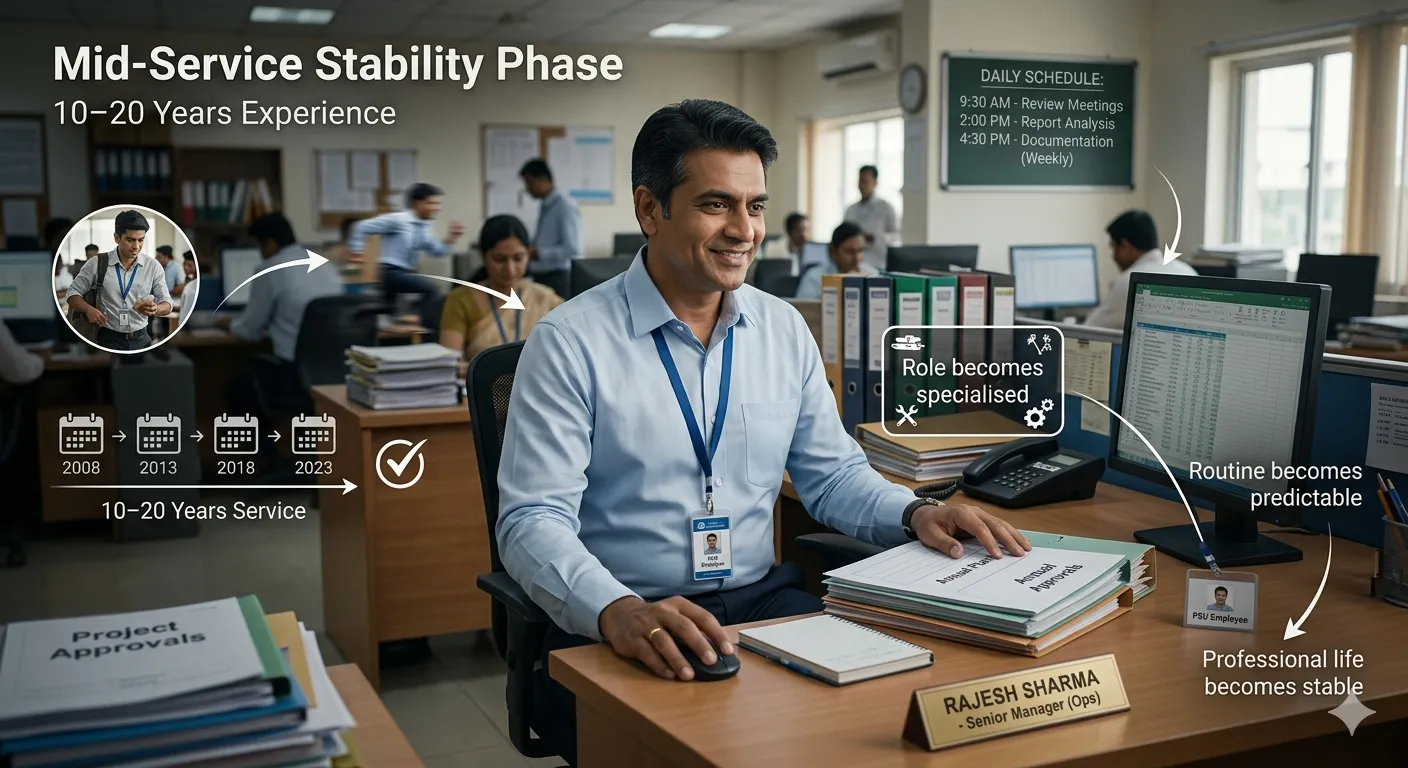
After 10–20 years, professional life often becomes more predictable.
Roles become specialised.
Responsibilities become administrative.
Schedules become structured.
Work becomes more desk-oriented.
Meetings increase.
Screen time increases.
Movement becomes optional rather than necessary.
The body gradually adapts to this new rhythm.
This adaptation is subtle.
Because stability increases at the same time.
Salary continuity improves.
Professional confidence improves.
Family life becomes more organised.
Everything externally appears stronger.
Yet internally, physical rhythm slowly adjusts to reduced movement patterns.
Routine Influences Physical Rhythm.
Human physiology responds to daily behaviour patterns.
When daily life includes natural movement, the body maintains higher activity readiness.
When movement reduces gradually, the body adapts to lower physical demand.
Over many years, sitting duration often increases.
Walking decreases.
Unplanned activity reduces.
Routine becomes efficient.
But efficiency sometimes reduces variability.
Variability plays an important role in maintaining physical engagement.
Small differences repeated daily influence long-term patterns.
Reduced walking distance.
Limited physical effort during working hours.
More time spent in seated posture.
Each factor individually appears insignificant.
But combined over long durations, they influence perceived energy levels.
Silent Acceptance.
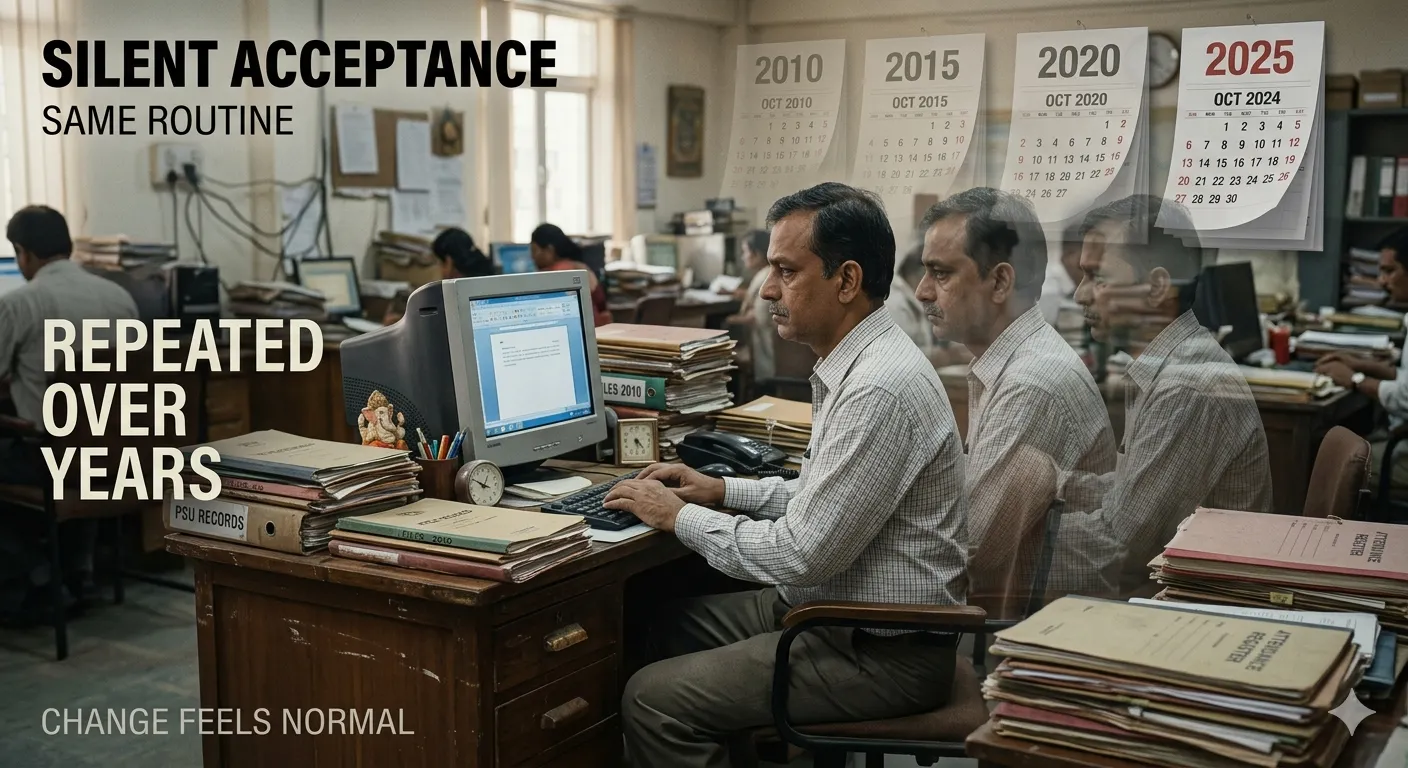
Many PSU employees do not immediately connect declining energy with structured routine.
Because the change happens slowly.
Gradually.
1 Almost unnoticeably.
2 Professional continuity remains strong.
3 Work responsibilities continue smoothly.
4 Daily productivity remains stable.
5 There is no immediate disruption.
6 So the topic rarely becomes urgent.
Energy variation is often accepted as normal progression.
Statements such as:
“Energy naturally reduces with time.”
“This is part of long service.”
“Work responsibility increases, so physical effort reduces.”
These thoughts feel reasonable.
Because structured careers prioritise reliability.
Reliability prioritises consistency.
Consistency sometimes reduces variation.
And variation influences vitality.
Physical Energy and Mental Rhythm.
Physical rhythm and mental rhythm are interconnected.
When physical engagement is present, mental alertness often feels stable.
Reduced physical variation may influence perceived sharpness over long durations.
Decision-making speed may feel slightly different.
Sustained concentration may require more effort.
Recovery after demanding days may take longer.
These changes are usually subtle.
Not dramatic.
Yet noticeable internally.
Many PSU employees experience this phase silently.
Because external stability remains intact.
Career continues.
Income continues.
Professional identity continues.
Therefore, the internal observation often remains private.
Understanding the Pattern.
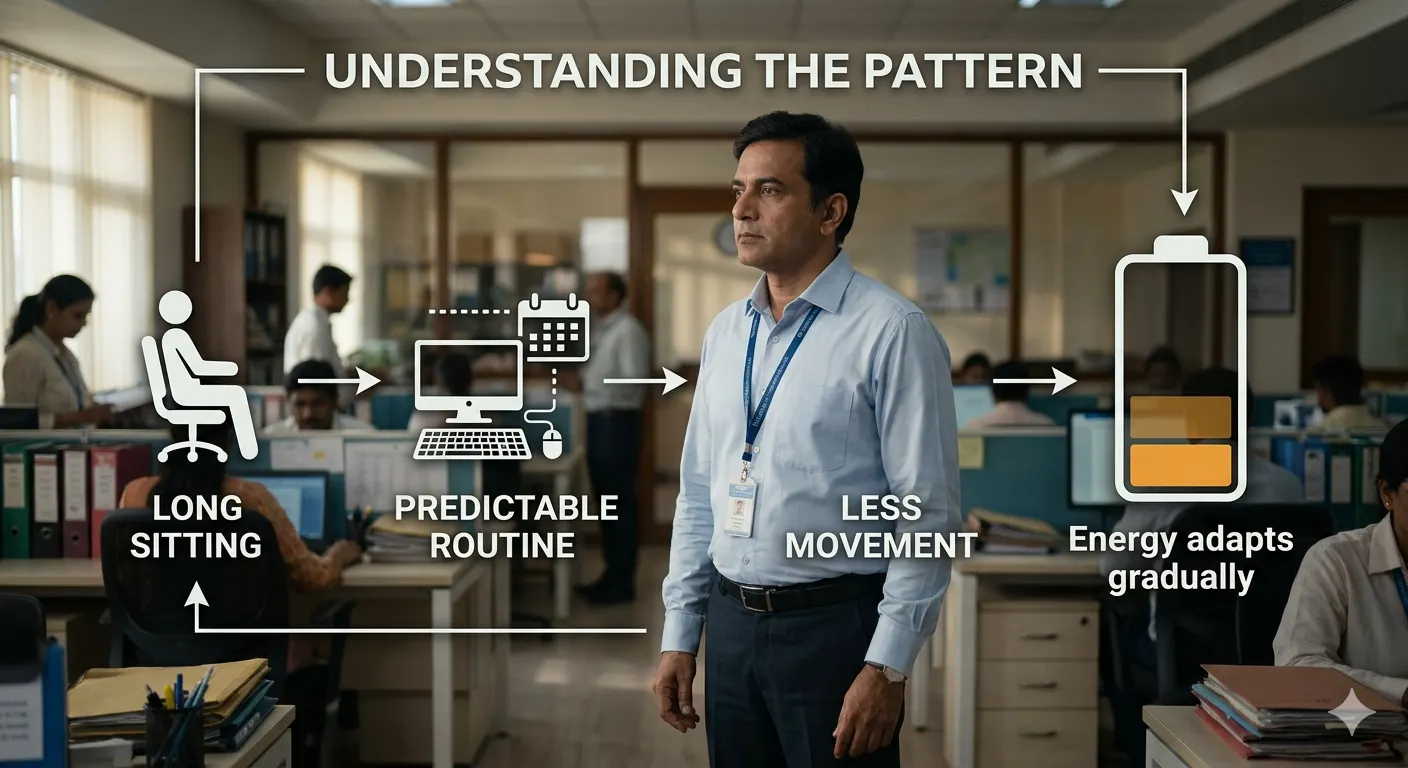
Declining energy is not always a direct consequence of age alone.
It often reflects accumulated lifestyle rhythm.
Structured work environments influence behaviour gradually.
Gradual influence produces gradual outcomes.
Long-term sitting patterns.
Predictable schedules.
Reduced daily variability.
Limited spontaneous movement.
These factors together influence physical rhythm.
Understanding this connection helps interpret personal experience more calmly.
Awareness reduces unnecessary concern.
Clarity improves understanding.
Understanding improves confidence.
Confidence reduces hesitation.
Observation becomes easier when interpretation becomes clearer.
Nothing Dramatic, Yet Meaningful.
Energy patterns rarely change overnight.
They evolve slowly.
Over years of structured professional life.
This evolution is not unusual.
It is not abnormal.
It is often simply an adaptive response to stable routine patterns.
When something is understood, it becomes easier to observe without discomfort.
Observation creates perspective.
Perspective creates clarity.
Clarity often begins with awareness.
A Gentle Perspective.
Structured PSU careers provide strong professional continuity.
Continuity supports financial planning.
Continuity supports family stability.
Continuity supports long-term predictability.
At the same time, continuity also influences daily rhythm.
Daily rhythm influences lifestyle behaviour.
Lifestyle behaviour influences physical energy patterns over long durations.
Understanding this relationship often provides reassurance.
Nothing is necessarily wrong.
Often, patterns are simply becoming visible.
And visible patterns allow better awareness.
Awareness allows calmer interpretation.
Calm interpretation allows thoughtful understanding.
Understanding often becomes the first step towards long-term wellbeing clarity.
Closing Thought.
Many PSU employees observe gradual changes in physical energy after long years of service.
Often silently.
Often without discussion.
Yet the experience is common across structured professional environments.
Understanding lifestyle rhythm helps explain these observations.
And explanation reduces uncertainty.
Nothing is wrong.
Awareness is increasing.
And awareness often becomes the beginning of clarity.