
PSU Employees: High Salary, Strong Job Security — But Why Is Wealth Still Average?
PSU Employees: High Salary, Strong Job Security — But Why Is Wealth Still Average?
Feb 15, 2026

In India, a PSU (Public Sector Undertaking) job has always been considered one of the most secure, prestigious, and financially stable career paths.
Organizations like Indian Oil, ONGC, NTPC, HPCL, and BPCL offer excellent salaries, strong job security, and multiple financial benefits.
Many PSU employees earn ₹1 lakh to ₹2 lakh or more per month. They receive Dearness Allowance (DA), bonuses, overtime, medical benefits, pension security, and easy access to bank loans.
On paper, everything looks financially perfect.
Yet, there is an uncomfortable truth that most people do not talk about.
Even after 20–25 years of service, many PSU employees are still not financially free.
The question is not about income.
The real question is: Why is wealth not growing at the same pace as salary?
The Problem Is Not Salary — The Problem Is Strategy
PSU employees are highly skilled professionals.
They manage complex systems, operate high-risk infrastructure, and work with discipline and precision.
They are trained to:
• Achieve targets
• Follow systems and procedures
• Improve performance metrics
• Earn promotions
However, they are rarely trained in financial strategy.
Most employees are never taught:
• How to close loans faster
• How to calculate investment returns
• How to use leverage responsibly
• How to convert salary into income-generating assets
This gap between income and financial strategy is the primary reason wealth creation remains slow.
The Home Loan Trap: The Most Common Financial Reality
Let us consider a simple example.
A PSU employee takes a home loan of ₹50 lakh.
Interest rate: 8.5%
Tenure: 25 years
EMI: Approximately ₹40,000 per month
Now let us examine the first year.
Annual payment: ₹40,000 × 12 = ₹4,80,000
Out of this:
₹4,20,000 goes toward interest
₹60,000 goes toward principal
This means nearly 90% of the payment goes to the bank, and only 10% contributes to actual ownership.
Technically, the employee owns the house.
Financially, the bank controls it for most of the loan period.
If this structure continues for 25 years, the employee ends up paying several lakhs, sometimes crores, in interest.
This significantly slows wealth creation.
EMI Strategy: How Smart Employees Close Loans Faster

Taking a loan is not a mistake.
Not managing the loan strategically is the mistake.
There are three powerful strategies that can reduce loan tenure dramatically.
Strategy 1: Pay One Extra EMI Every Year
By paying one additional EMI annually, a 25-year loan can be reduced to around 20 years.
This saves years of payments and lakhs in interest.
Strategy 2: Increase EMI Every Year with Salary Growth
Most PSU employees receive annual increments and DA increases.
If EMI is increased by just 7–8% annually, the loan tenure can reduce to 15–17 years.
Strategy 3: Combine Both Strategies
By combining extra EMI and annual EMI increases, a 25-year loan can potentially be closed in 10–12 years.
This frees up cash flow much earlier and accelerates wealth creation.
Property Investment Without Yield Calculation: A Major Financial Mistake
Real estate is the most preferred investment for PSU employees.
However, one critical factor is often ignored: Rental Yield.
Let us consider an example.
Property value: ₹1 crore
Monthly rent: ₹20,000
Annual rent: ₹20,000 × 12 = ₹2,40,000
Rental yield calculation:
(₹2,40,000 ÷ ₹1,00,00,000) × 100 = 2.4%
This means the property generates only 2.4% annual return.
Now compare this with loan interest of 8.75%.
Difference: 8.75% – 2.4% = 6.35% negative gap
This means the employee is losing financially every year.
Without proper yield analysis, property becomes an emotional decision rather than a financial decision.
Smart Employees vs Average Employees.
Average PSU Employee:
• Pays EMI regularly
• Keeps money in fixed deposits
• Relies entirely on salary
• Waits for promotions and increments
• Feels secure due to job stability
Smart PSU Employee:
• Uses EMI reduction strategies
• Calculates investment returns
• Uses leverage carefully
• Activates idle money
• Converts salary into income-generating assets
The difference is not income.
The difference is financial awareness and strategy.
Dead Money: The Silent Wealth Killer.
Most employees keep large balances in savings accounts or fixed deposits.
Savings account return: approximately 3%
Loan interest: approximately 9%
This creates a negative difference of 6%.
This means idle money is losing financial potential.
Smart financial management focuses on reducing liabilities and increasing productive assets.
The Real Meaning of Financial Independence
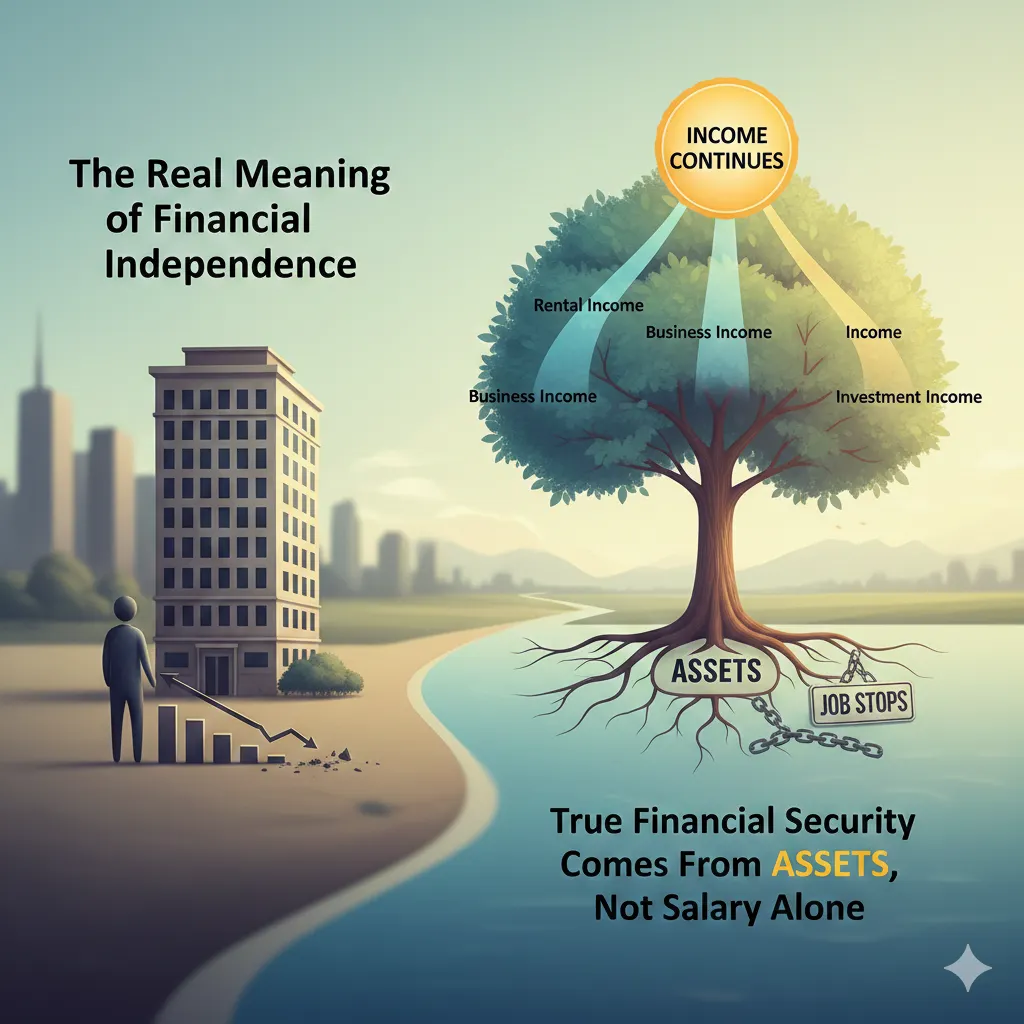
Financial independence means your survival does not depend entirely on your salary.
Even if your job stops, your income continues through assets such as:
• Rental income
• Business income
• Investment income
True financial security comes from assets, not salary alone.
The PSU Advantage: A Powerful Opportunity.
PSU employees already have a strong advantage:
• Stable income
• Easy loan access
• Long-term career security
• Predictable salary growth
When combined with proper financial strategy, this advantage can create extraordinary wealth over time.
The Five-Step Financial Roadmap for PSU Employees
To accelerate wealth creation,PSU employees should focus on:
- Closing loans faster
- Calculating rental yield before investing
- Using leverage responsibly
- Activating idle savings
- Improving financial education
These steps transform salary into long-term wealth.
Final Truth: Salary Alone Does Not Create Wealth
Salary provides comfort.
Strategy creates freedom.
Promotion gives designation.
Financial intelligence gives independence.
A PSU job is a powerful platform.
But wealth is created only when salary is converted into assets that generate income.
Conclusion: Awareness Is the First Step Toward Financial Freedom
PSU employees are already in a strong position.
With the right financial strategy, they can achieve true financial independence much faster.
The goal is not just to earn a high salary.
The goal is to build lasting wealth.
Because ultimately:
Salary helps you survive.
But financial intelligence helps you become free.
Ramjee Meena:
Financial freedom is not about how much salary you earn. It is about how intelligently you use that salary.
PSU employees already have one of the strongest foundations — stable income, security, and opportunity.
The only missing link is financial strategy. Once you understand how to convert income into assets, your job will no longer be your only source of security. Your wealth will work for you.
Blog Closing.
This piece is not intended to resolve financial questions or offer direction.
It exists simply to recognise a shared experience within PSU life.
Clarity does not always begin with action.
Sometimes, it begins with seeing clearly.
— Ramjee Meena
Founder, PSUPEDIA