PSU Employees & Mental Health
When Tiredness Slowly Becomes “Normal”
PSU Employees & Mental Health When Tiredness Slowly Becomes “Normal”
Jan 07, 2026
Most PSU employees never say,
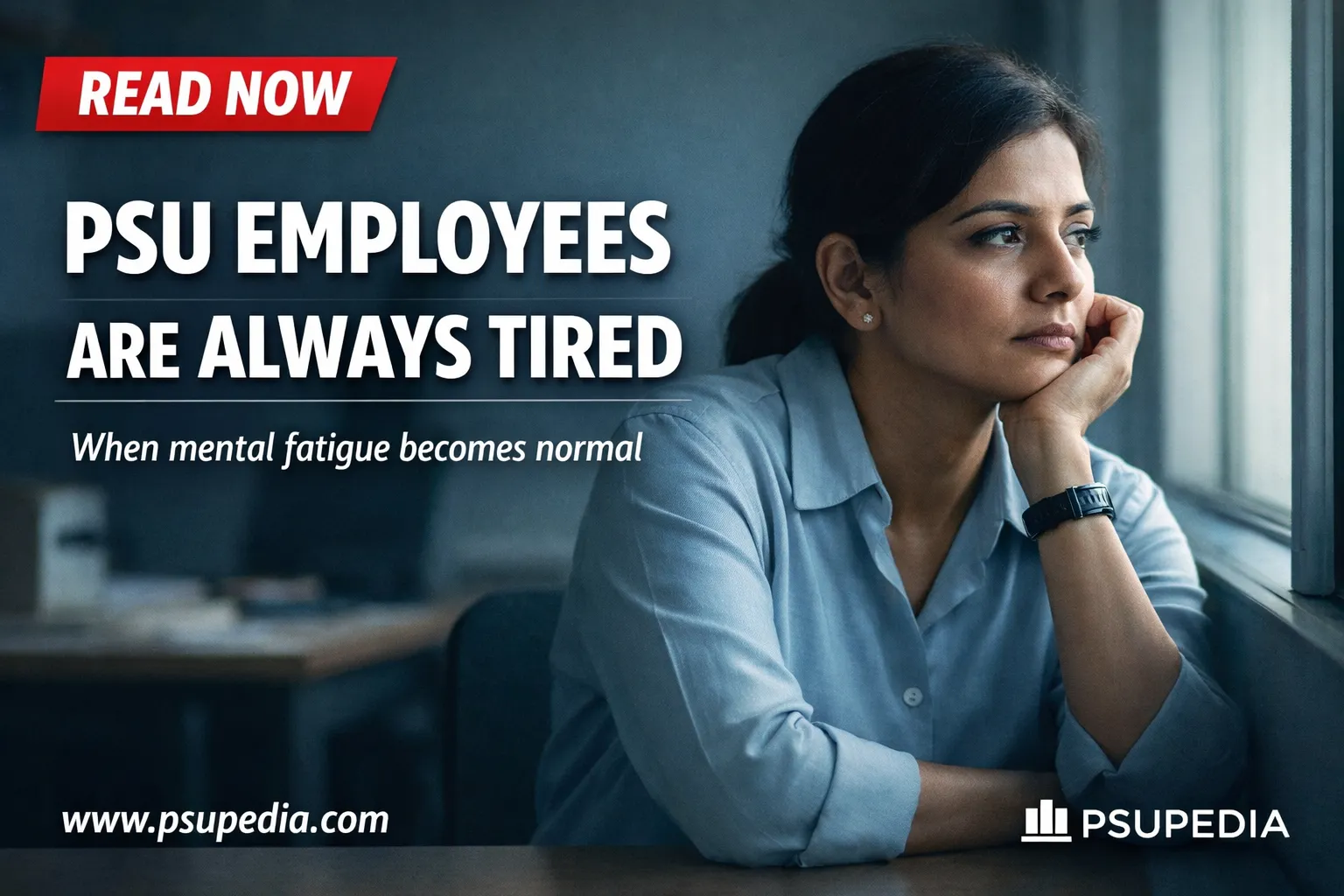
“I am mentally struggling.”
Not because everything is fine,
but because what they feel does not look serious enough to be called a problem.
There is no panic.
No breakdown.
No visible crisis.
So the feeling is dismissed.
Instead, we use softer and safer words.
“I’m fine.”
“I’m just tired.”
“It’s work pressure.”
“It’s age.”
These words sound harmless.
They sound responsible.
They sound mature.
And because work continues, files move, meetings happen, and responsibilities are fulfilled, everyone — including ourselves — assumes everything is okay.
But this tiredness is different.
The Tiredness That Does Not Ask for Attention.
This is not the kind of tiredness that forces you to stop working.
It does not interrupt productivity.
It does not demand sympathy.
It does not create urgency.
It quietly stays in the background of life.
You wake up with it.
You carry it through the workday.
You return home with it.
It becomes part of your routine — so familiar that it no longer feels unusual.
Day after day.
Year after year.
Because it allows you to function, it stops being questioned.
And because it is not dramatic, it remains invisible.
The PSU Environment and the Shape of Responsibility.
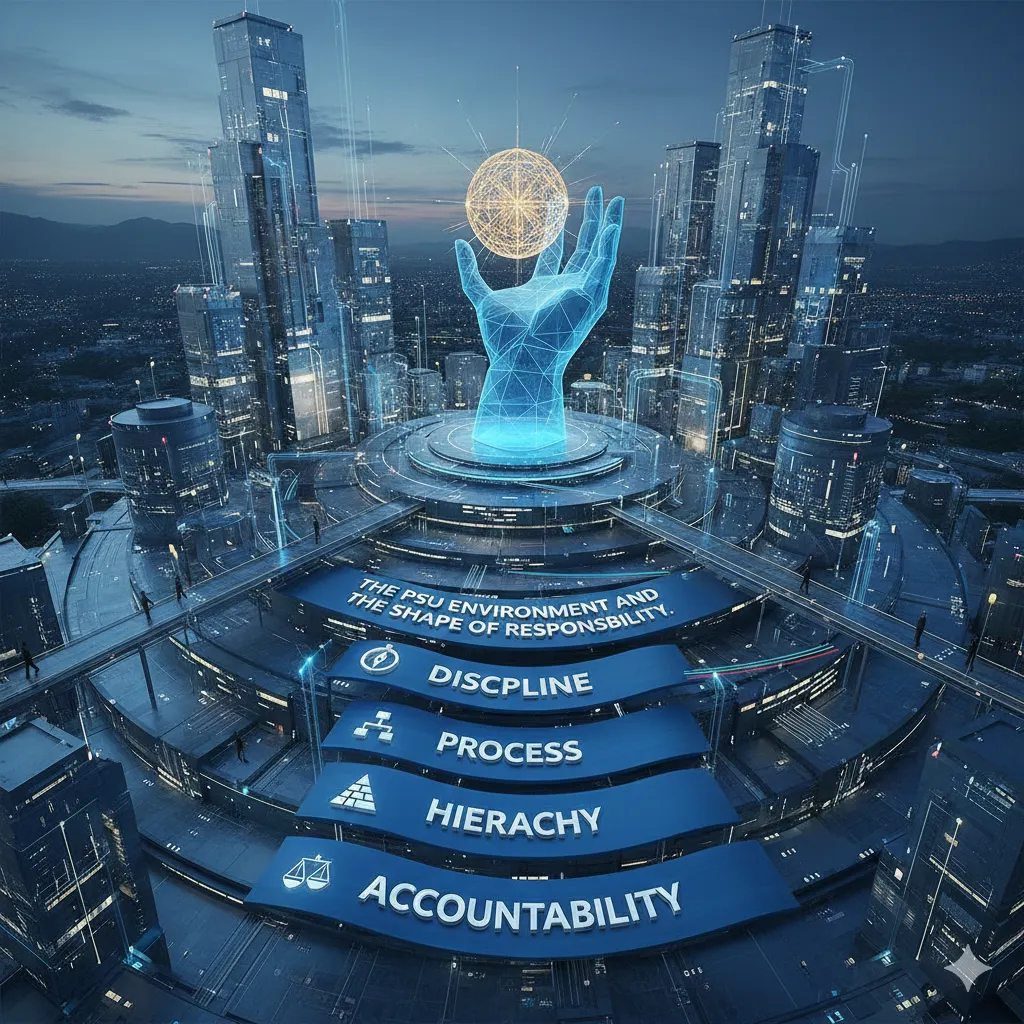
Public Sector Undertakings are built on strong values.
Discipline.
Process.
Hierarchy.
Accountability.
These values create stability — not just for organisations, but also for employees.
They bring structure, predictability, and a sense of order.
But over time, these same values also shape how employees relate to themselves.
Without realising it, PSU employees learn certain unspoken rules.
You learn to stay composed, no matter what you feel.
You learn to manage pressure quietly.
You learn that emotional expression is unnecessary, sometimes even undesirable.
Complaints are avoided.
Reactions are controlled.
Adjustments are made silently.
This does not happen in one year.
It happens gradually, across decades.
And slowly, the mind adapts.
Emotional Control as a Professional Skill.
In PSU work culture, emotional control is often seen as professionalism.
Not reacting is seen as maturity.
Not complaining is seen as strength.
Not expressing is seen as discipline.
So employees train themselves to stay functional under all conditions.
Even when tired.
Even when overwhelmed.
Even when mentally drained.
Over time, the mind learns a silent instruction:
“Stay alert. Stay responsible. Don’t switch off.”
This instruction does not end with office hours.
The body may leave the workplace,
But the mind continues to carry the role.
Planning tomorrow.
Replaying today.
Anticipating future responsibilities.
Rest becomes physical, not mental.
Living with an “Always ON” Mind.

Years pass.
You sleep regularly, yet wake up without feeling refreshed.
You take leave, yet the mind does not fully relax.
You sit with family, yet your thoughts drift elsewhere.
You do not feel sad.
You do not feel anxious.
So you do not see a problem.
You just feel mentally drained — without a clear reason.
There is no single incident you can point to.
No crisis you can name.
No moment where things “went wrong.”
Just a constant background fatigue.
Because it is manageable, it is accepted.
“This is life.”
“This is duty.”
“This is how it is.”
Slowly, expectations from inner peace reduce.
Why PSU Employees Rarely Notice the Signal.
One important truth about PSU employees is this:
They are trained to endure.
Endurance is rewarded.
Stability is respected.
Consistency is valued.
So when mental fatigue arrives slowly — not as pain, but as dullness — it is not recognised as a signal.
Instead, it is mislabelled.
As maturity.
As professionalism.
As responsibility.
But endurance without emotional rest always comes with a cost.
That cost is not loud.
It is paid quietly.
Clarity begins to reduce.
Patience begins to thin.
Joy becomes less frequent.
Not suddenly.
Not dramatically.
Very slowly.
When Functioning Replaces Feeling.
Over time, many PSU employees become very good at functioning.
They show up.
They deliver.
They manage.
But somewhere along the way, feeling takes a back seat.
Not because it is unimportant,
but because it feels inconvenient.
Emotions are postponed.
Internal fatigue is ignored.
Mental rest is deprioritised.
This does not make someone weak.
It makes them responsible — perhaps too responsible.
And responsibility, when carried without pause, becomes heavy.
This Is Not a Personal Failure.
It is important to say this clearly:
This is not weakness.
This is not failure.
This is not something “wrong” with you.
This is the result of years of responsibility carried consistently, quietly, and without interruption.
Years of staying composed.
Years of staying functional.
Years of staying silent.
And the most important step here is not immediate action.
It is recognition.
Just understanding:
“This did not happen overnight.”
“This has a context.”
“This has a reason.”
That understanding alone can create space inside the mind.
The Role of Awareness
At PSUPEDIA, the focus is not on diagnosis.
It is not on solutions.
It is not on quick fixes.
The focus is on awareness.
Because awareness changes the relationship you have with yourself.
When you stop blaming yourself for feeling tired,
you start understanding yourself.
And understanding is where clarity begins.
A Quiet Closing Thought.

Mental fatigue does not always announce itself.
Sometimes, it simply becomes “normal.”
And recognising that quiet normal
is often the first honest step.
Explore more thoughtful content for PSU employees at:
PSUPEDIA
Where conversations are slow, honest, and pressure-free.
Providing clear, responsible real estate guidance exclusively for PSU employees.
Join us on Facebook for more practical financial guidance for PSU employees:
👉 https://www.facebook.com/psupedia
Subscribe to our YouTube channel for more such insights
👉 https://www.youtube.com/watch?v=R2G8df31tXg
It is only meant to acknowledge a feeling many PSU employees quietly carry.
Career expectations do not always fail.
Sometimes, they simply remain unchanged — while reality evolves.
If this piece felt familiar, sit with it.
No action is required. No conclusion is necessary.
PSUPEDIA exists to reflect these unspoken experiences —
slowly, honestly, and without pressure.
More reflections will follow.
Host: Ramjee Meena