
The Quiet Stress PSU Employees Rarely Talk About
The Quiet Stress PSU Employees Rarely Talk About
Jan 21, 2026
In PSU life, stress rarely arrives in obvious or dramatic ways.
It does not come with panic attacks or visible breakdowns.
It does not announce itself clearly, and that is precisely why it often goes unnoticed.
Most of the time, it doesn’t even feel like stress.
It feels like routine.
It feels like adjustment.
It feels like responsibility.
And because it feels familiar, it is rarely questioned.
This stress arrives quietly — between routine files that look the same every year, between transfer orders that rearrange life again and again, and between waiting cycles that stretch longer than expected, sometimes without clarity or explanation.
Many PSU employees don’t name this experience as stress at all. They simply call it “part of the system” or “normal PSU life.”
Yet the body and the mind still record it.
Stress That Doesn’t Look Like Stress.
This form of stress is very different from crisis-based stress. There is no urgency attached to it.
There is no immediate danger, no sudden shock, and no clear problem demanding a solution.
From the outside, everything looks stable. The job is secure. The salary is predictable. Service rules are clearly defined.
On paper, this should feel comforting.
And yet, internally, something keeps repeating.
A quiet mental tiredness without a clear reason. A low-grade irritation that doesn’t match the situation. A sense that life is moving forward in years, but personally something feels paused.
Because this stress doesn’t look serious, it rarely feels valid enough to talk about. It is not loud enough to complain about, and not obvious enough to be recognised.
When Structure Feels Supportive.
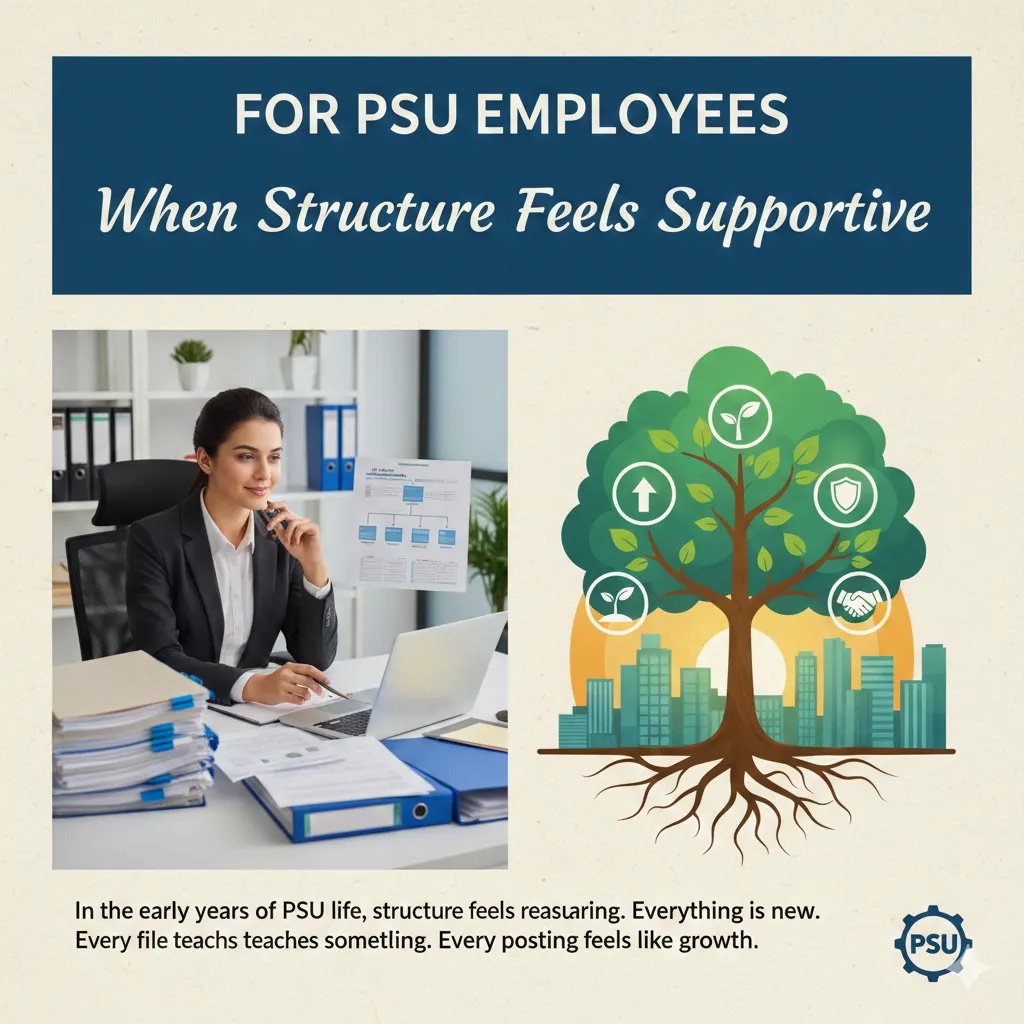
In the early years of PSU life, structure feels reassuring. Everything is new. Every file teaches something. Every posting feels like growth.
Transfers are accepted with curiosity. Waiting feels temporary. Energy feels available.
At this stage, the system feels like it is helping you grow. Security feels like freedom because it removes uncertainty.
It provides stability, direction, and a sense of safety.
For many employees, this phase builds trust in the system.
When Repetition Starts to Register.
As years pass, the experience begins to change.
Routines start repeating. Files begin to look familiar.
Processes stop feeling new. Transfers slowly feel less like opportunity and more like disruption.
Family routines reset again. Children adjust schools again. Social circles rebuild again.
And waiting becomes permanent.
Waiting for postings.
Waiting for promotions.
Waiting for confirmations.
Waiting for approvals.
What was once patience gradually becomes a way of life.
Without realising it, waiting starts shaping identity.
The Quiet Internal Dialogue.

At this stage, many PSU employees begin having quiet internal conversations:
“I am secure… so why do I feel tired?”
“Others would love this job… so why do I feel restless?”
“Nothing is technically wrong… yet something feels unresolved.”
These questions are rarely shared.
Gratitude is expected. Security exists. Dissatisfaction feels unjustified.
So these questions stay inside. They don’t disappear. They simply settle quietly in the background.
Why This Reality Is Often Misunderstood.
This experience is often misunderstood as lack of ambition, ingratitude, or mid-life restlessness. But it is none of these.
It is not a personal failure or a character flaw. It is the emotional load of long-term structure.
Security reduces risk, but it does not eliminate emotional load. It only makes emotional load less visible — and easier to ignore.
What Happens When Stress Is Not Named.
When this stress is not named or acknowledged, it does not explode. It accumulates.
It becomes background noise in daily life. It shows up as mental tiredness that rest does not fully fix, irritation that feels out of character, reduced enthusiasm without a clear cause, and decisions delayed because “there’s no urgency.”
Slowly, the cost builds.
Months of mental energy are lost every year. Health signals are ignored.
Relationships absorb unspoken frustration. Life begins to feel paused while years continue moving.
Nothing breaks suddenly, but something slowly wears down.
Why PSU Employees Rarely Talk About This.
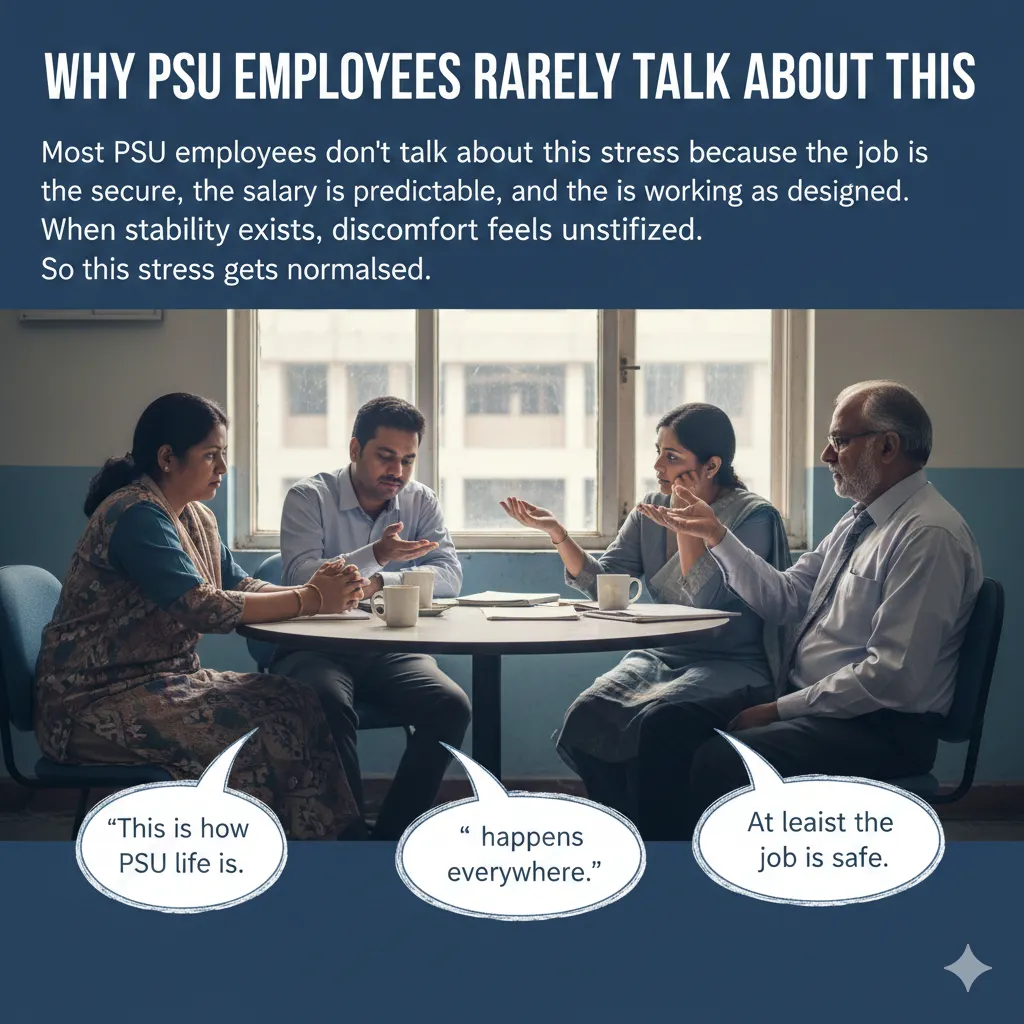
Most PSU employees don’t talk about this stress because the job is secure, the salary is predictable, and the system is working as designed.
When stability exists, discomfort feels unjustified.
So this stress gets normalised.
“This is how PSU life is.”
“This happens everywhere.”
“At least the job is safe.”
And slowly, people stop examining their own experience.
What a Current Reality Check Really Does.
A Current Reality Check does not ask you to change anything. It does not ask you to rebel or disturb stability.
It simply asks you to see clearly.
When reality is named honestly, it loses weight. When stress is acknowledged, it stops leaking into health, relationships, and everyday decisions.
Awareness reduces pressure without changing systems.
A Personal Reflection.
From my own experience, I realised something important. I was not reacting to the job itself. I was reacting to unexamined repetition and waiting.
Once I understood this clearly, the pressure reduced — not because the system changed, but because my relationship with it became clearer.
If awareness saves even three months of mental peace in a year, that is not a small thing. That is clarity regained.
This is how I saved time, money, and effort — by understanding reality before reacting to it.
A Gentle Closing Thought.
If this reflection feels familiar, remember this:
Nothing is wrong with you.
You are not ungrateful.
You are not failing.
You are simply becoming more aware.
And awareness is always the first step toward clarity.
— Ramjee Meena
Founder, PSUPEDIA