
When Poor Physical Health Becomes “Normal” in PSU Life
When Poor Physical Health Becomes “Normal” in PSU Life
Feb 03, 2026
In most PSU careers, physical health does not collapse suddenly.
It fades slowly.
So slowly that many employees do not notice the exact moment things changed.
There is no clear event.
No single illness.
No dramatic breakdown.
Just a gradual shift — where feeling tired becomes familiar, movement reduces, and discomfort quietly blends into routine.
Over time, this state begins to feel normal.
How Health Decline Becomes Invisible.
Most PSU employees join service with reasonable physical capacity.
Energy feels sufficient.
Late nights are manageable.
Travel feels routine, sometimes even enjoyable.
In the early years, the body adapts easily.
But PSU service is not a short phase.
It is a long, continuous system.
As years pass, routines solidify.
Long sitting hours replace natural movement.
Meetings replace regular meals.
Sleep adjusts itself around postings, shifts, and deadlines.
None of this feels alarming at first.
It feels practical.Necessary.
Part of responsibility.
The Gradual Signs No One Questions.
The body begins sending small signals.
Weight increases slowly.
Stamina reduces.
Fatigue appears earlier in the day.
Recovery takes longer.
These signals are rarely treated as warnings.
Instead, they are explained away.
“This happens after forty.”
“Everyone in my department is the same.”
“Service life doesn’t allow time.”
What could have been noticed becomes normalised.
Not ignored deliberately —
just quietly accepted.
Why PSU Culture Encourages Acceptance.
PSU environments value endurance.
Showing up matters.
Managing pressure matters.
Staying functional matters.
Listening to the body, however, is rarely acknowledged.
There is an unspoken respect for pushing through discomfort.
For adjusting.
For managing without complaint.
Over time, this creates a silent conditioning.
Health decline is not questioned —
it is tolerated.
And tolerance slowly turns into identity.
“This is just how service life feels.”
The Difference Between Neglect and Conditioning.
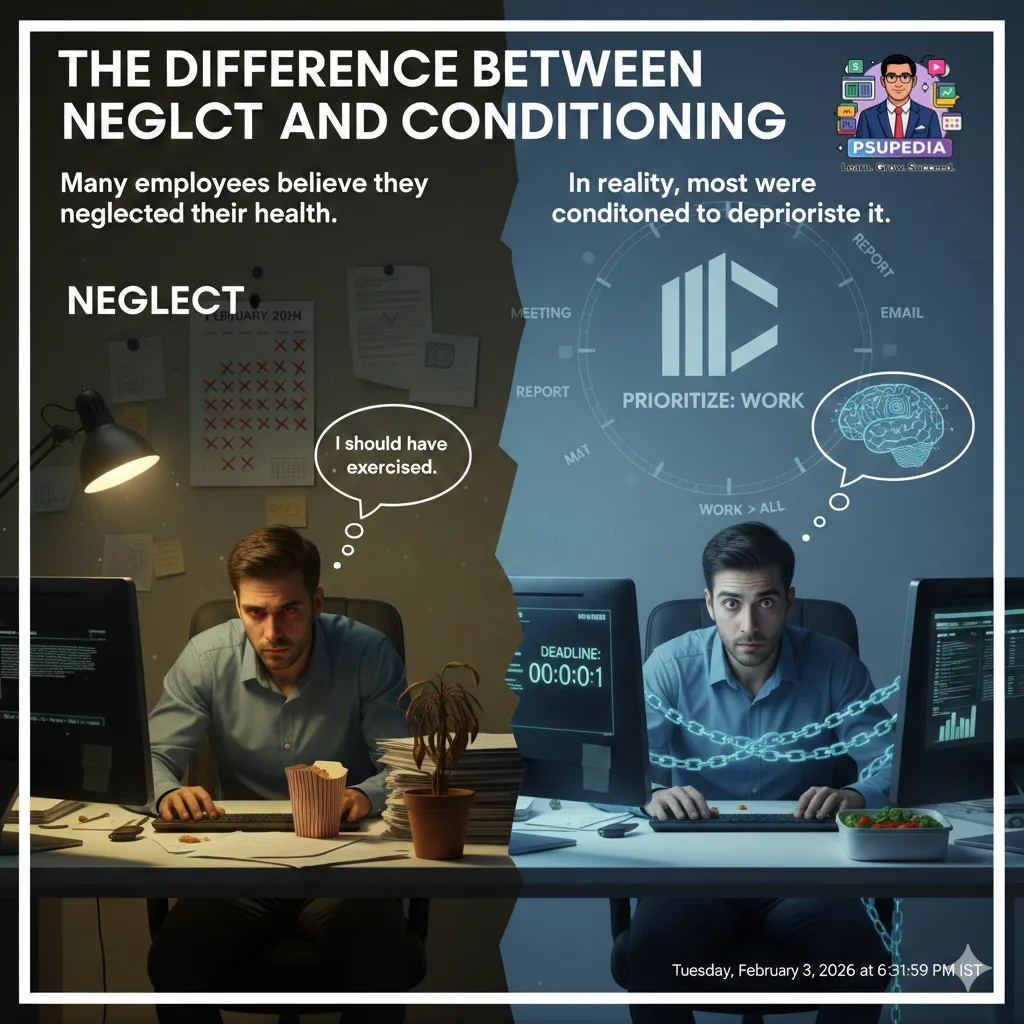
Many employees believe they neglected their health.
In reality, most were conditioned to deprioritise it.
Health was never rejected.
It was simply postponed.
“After this posting…”
“Once things settle…”
“After retirement…”
Years pass inside these statements.
And the body adapts —
not by improving,
but by lowering expectations.
Reduced energy becomes the baseline.
Fatigue becomes familiar.
Discomfort becomes background noise.
Why This Decline Feels Non-Urgent.
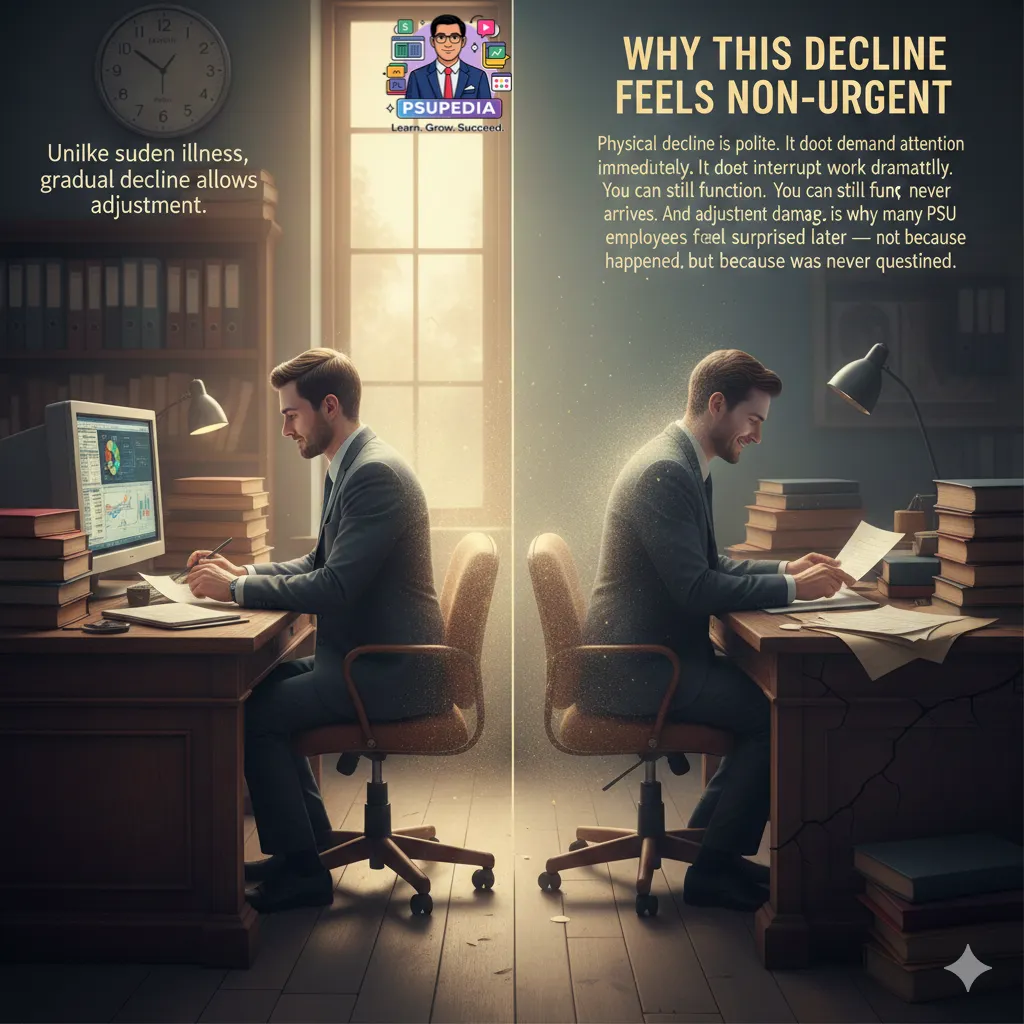
One reason this pattern continues is that physical decline is polite.
It does not demand attention immediately.
It does not interrupt work dramatically.
You can still function.
You can still manage.
So urgency never arrives.
Unlike sudden illness, gradual decline allows adjustment.
And adjustment hides damage.
This is why many PSU employees feel surprised later —
not because decline happened,
but because it was never questioned.
The Cost of Silent Acceptance.
The cost of this acceptance is rarely calculated.
It is not just medical.
It shows up as:
Lower daily energy
Reduced mental clarity
Slower recovery from stress.
Shorter attention spans
Over years, effectiveness reduces —
not suddenly, but steadily.
Yet because decline was labelled “normal,”
it was never addressed internally.
Why Awareness Feels Uncomfortable.
Recognising this pattern often feels unsettling.
Because it challenges a long-held belief:
“That this is just how PSU life works.”
Awareness does not accuse the system.
It does not blame the individual.
It simply notices something that was previously unnamed.
And naming something quietly changes the relationship with it.
This Stage Is Not About Action.
It is important to clarify what this reflection is not.
It is not about fitness plans.
It is not about routines or discipline.
It is not about fixing anything.
It is about recognising when physical decline has been mislabelled as normal.
That recognition alone is significant.
Because what is seen clearly is no longer invisible.
A Shared Experience, Not a Personal Failure.
Many PSU employees carry this experience silently, assuming it is personal.
It isn’t.
It is systemic.
It is cultural.
It is shared.
Long service life, repeated adjustments, and constant responsibility create this pattern naturally.
Reaching this awareness does not mean something went wrong.
It means something important became visible.
Blog (Final) Continue Learning.
Physical health in PSU life rarely breaks down loudly.
It fades quietly — when endurance is rewarded and attention is postponed.
Recognising this pattern is not about blame or correction.
It is about clarity.
Many PSU employees reach this stage not because they ignored themselves,
but because they adapted for too long without questioning the cost.
If this reflection felt familiar,
it simply means awareness is returning.
And awareness is always the first step toward wellbeing —
without pressure, without extremes.
— Ramjee Meena
Founder, PSUPEDIA