
When Professional Stability Quietly Changes Emotional Presence at Home
When Professional Stability Quietly Changes Emotional Presence at Home
Feb 13, 2026
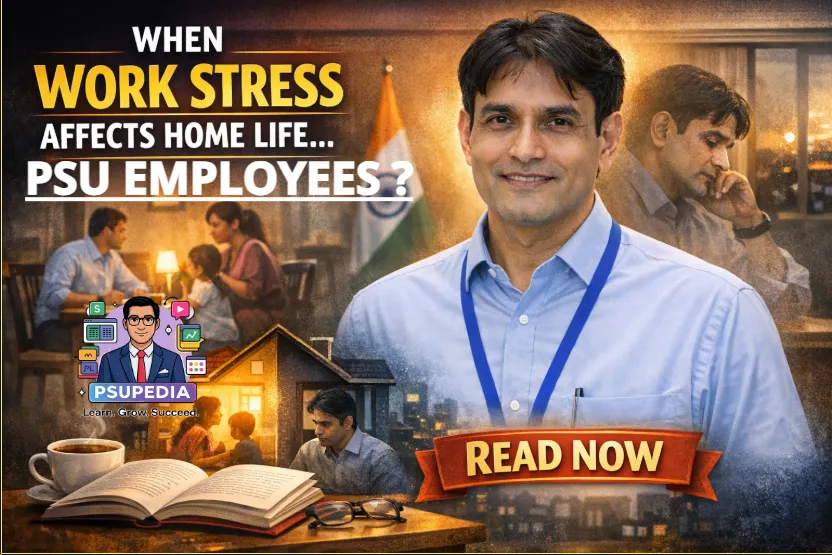
In PSU life, stability is one of the strongest foundations.
Salary arrives on time.
Career progression follows a defined structure.
Responsibilities are clear.
And compared to many private sector roles, there is predictability.
From the outside, this appears to be an ideal professional life.
But beneath this stability, there is another reality that often goes unnoticed — the silent psychological weight of sustained responsibility.
This stress does not appear suddenly.
It does not announce itself loudly.
It accumulates gradually, through routine.
Through review meetings.
Through approval delays.
Through performance expectations.
Through transfers that must be accepted without resistance.
Individually, these may seem like normal parts of PSU service.
But collectively, they create a continuous mental load.
And over time, this load does not remain confined to the office.
It travels with you.
The Early Career Phase: When Pressure Feels Like Progress.
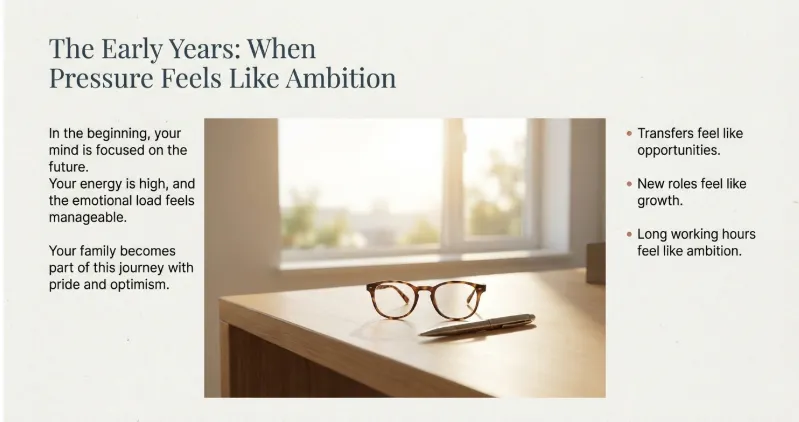
In the early years of PSU service, professional pressure often feels energising.
Transfers feel like opportunities to grow.
New roles bring excitement.
Long working hours feel meaningful.
The future appears full of possibilities.
At this stage, the mind is focused on building a career.
Responsibility feels like progress, not burden.
Family members share this optimism.
There is pride.
There is emotional engagement.
There is a shared sense of direction.
Stress exists, but it feels temporary and manageable.
The Mid-Career Shift: When Responsibility Becomes Heavier.
As years pass, something begins to change.
Around ten to fifteen years into service, the nature of stress evolves.
Responsibility becomes more real.
Decisions carry longer-term consequences.
The margin for error feels smaller.
The internal dialogue becomes more cautious.
You begin to think more frequently:
“What if this decision creates complications later?”
“What if a transfer disrupts family stability?”
“What if performance evaluation affects future progression?”
These thoughts are rarely expressed openly.
They remain internal.
The mind begins to stay in a constant state of professional awareness.
Even outside the office, part of your attention remains engaged with work.
This is not intentional.
It is the natural outcome of sustained responsibility.
When Professional Stress Quietly Enters the Home.
After work, you return home.
Physically, you are present.
But mentally, part of your mind is still processing professional matters.
You sit with your family.
You participate in conversations.
You listen.
But your mental energy is divided.
A portion of your attention remains occupied with pending decisions, future uncertainties, or unresolved responsibilities.
This change is subtle.
It does not create immediate conflict.
There are no arguments.
There is no visible disruption.
But gradually, emotional presence begins to shift.
Conversations become shorter.
Engagement becomes slightly reduced.
Emotional availability becomes more limited.
Not because of lack of care.
But because of accumulated mental fatigue.
Family members may observe this change without fully understanding its cause.
They may interpret it as tiredness.
Or mood.
Or distraction.
Over time, this silent adjustment becomes normal.
And often, no one realises when it began.
The Hidden Cost of Silent Stress.
The cost of this silent stress does not appear in financial records.
It appears in moments that cannot be measured.
Missed conversations.
Reduced emotional warmth.
Limited mental presence during family time.
PSU service provides strong financial security.
But emotional wellbeing requires conscious protection.
Professional responsibility is necessary.
But carrying it mentally at all times can gradually reduce emotional balance.
This is not a personal weakness.
It is a structural outcome of working within a system that requires sustained precision, accountability, and stability.
Awareness: The Turning Point.
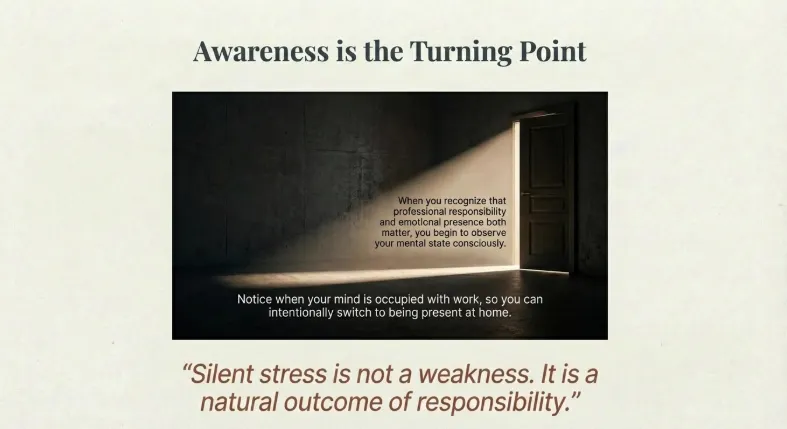
The most important shift begins with awareness.
When you recognise that silent stress exists, you begin to observe your mental state more clearly.
You begin to notice when your mind remains occupied unnecessarily.
You begin to separate professional responsibility from personal presence.
This awareness does not require dramatic lifestyle changes.
It begins with simple recognition.
Understanding that emotional presence at home is not automatic.
It must be protected consciously.
PSU service ensures financial stability.
But emotional stability depends on intentional awareness.
Both are equally important for long-term wellbeing.
Professional Stability and Emotional Balance Can Coexist.
PSU life offers structure, security, and long-term reliability.
These are valuable foundations.
But true stability is not only financial.
It is also emotional.
When awareness increases, balance improves.
Professional responsibilities remain intact.
But emotional presence becomes stronger.
Family relationships become more engaged.
Mental wellbeing becomes more sustainable.
This balance does not happen automatically.
It develops gradually, through understanding.
Closing Reflection.
Professional stress in PSU life is real.
But its impact is often silent.
It does not disrupt suddenly.
It shifts emotional presence gradually.
Recognising this reality is the first step toward restoring balance.
Not by reducing responsibility.
But by increasing awareness.
Because true success in PSU life is not only defined by professional stability.
It is also defined by emotional wellbeing, clarity, and long-term personal balance.
PSUPEDIA Continuity.
In the next article, we will explore how structured PSU environments gradually shape communication patterns — both at work and at home
— and how greater awareness can improve both professional effectiveness and personal relationships.
PSU life is a long journey.
Understanding its psychological and emotional dimensions makes that journey more balanced, more conscious, and more sustainable.
— Ramjee Meena
Founder, PSUPEDIA