
When PSU Careers Stay Stable but Energy Doesn’t
When PSU Careers Stay Stable but Energy Doesn’t
Jan 13, 2026

Physical decline in PSU life rarely announces itself. It shows up quietly — long before illness, warnings, or alarms.
The Kind of Change Nobody Talks About.
In most PSU careers, change is slow and predictable.
Designations rise gradually.
Responsibilities increase step by step.
Workflows become familiar.
Life begins to feel stable — sometimes even comfortable.
That is exactly why physical decline becomes difficult to notice.
For many PSU employees, health does not collapse suddenly.
There is no dramatic moment.
No emergency.
No clear warning.
Instead, something far quieter happens.
Energy reduces slowly.
Stamina feels slightly lower than before.
Recovery takes longer — but not enough to raise concern.
Because nothing feels serious, nothing feels urgent.
Stability: A Strength That Hides Weak Signals..
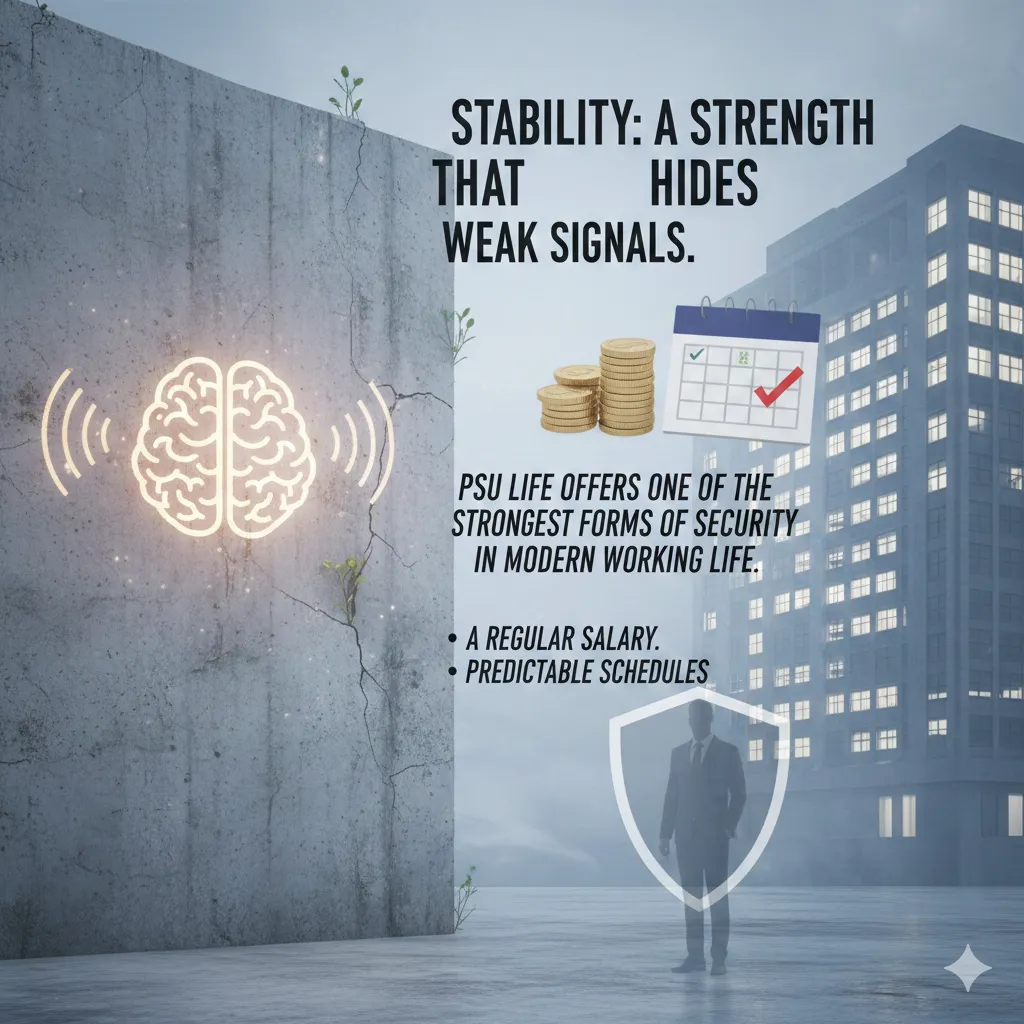
PSU life offers one of the strongest forms of security in modern working life.
A regular salary.
Predictable schedules.
Long-term continuity.
These are not small advantages.
They bring mental peace and financial confidence.
But stability also creates a blind spot.
When income is regular and work continues smoothly,
we assume the rest of life is also under control.
Health quietly slips into that assumption.
Most PSU employees continue performing well even as energy reduces.
Meetings are attended.
Reports are submitted.
Responsibilities are fulfilled.
So the body’s signals are ignored — not intentionally, but naturally.
Early Career Energy vs Mid-Career Reality..
Early in a PSU career, the body is forgiving.
Late nights do not matter much.
Sleep schedules are irregular, yet recovery is quick.
Meals are inconsistent, but energy returns.
Fatigue feels temporary.
There is margin in the system.
Mid-career is different.
Desk hours increase.
Screen time becomes constant.
Meetings stretch without gaps.
Shift patterns repeat for years, not months.
Travel becomes routine rather than exciting.
The body still functions — but it begins compensating.
And compensation always comes at a cost.
The Quiet Normalisation of Fatigue..

What makes this phase dangerous is not pain or illness.
It is normalisation.
Many PSU employees do not feel unhealthy.
They simply feel less energetic than before.
Evenings feel heavier.
Morning freshness reduces.
Weekends feel shorter, not because of time — but because of recovery.
Because these changes are slow, the mind explains them away.
“Maybe this is age.”
“Everyone feels like this.”
“Once things settle, I’ll focus on health.”
These thoughts feel reasonable.
They do not feel careless.
But they hide an important truth.
The Body Does Not Wait..
The body does not wait for retirement.
It does not wait for free time.
It does not wait for promotions to settle.
It keeps recording.
Every skipped recovery.
Every prolonged sitting hour.
Every repeated disruption.
Not dramatically.
Just consistently.
That is why decline feels confusing later.
There is no single cause to point at — because it was gradual.
A Simple Analogy That Explains Everything...
Physical energy loss in PSU life is like a phone battery.
The phone still lasts the day.
Calls go through.
Messages send.
But it no longer reaches 100%.
Because the phone still works, the issue feels minor.
So attention is delayed.
Until one day, charging feels incomplete.
And recovery feels slower than before.
That is when concern finally appears — late, but quietly.
A Personal Realisation...
From lived experience, one realisation becomes unavoidable:
Ignoring physical signals does not save time.
It consumes time later.
Low energy affects focus.
Fatigue influences patience.
Reduced stamina quietly shapes daily decisions.
As Ramjee Meena reflects from years of working around PSU environments,
early awareness is not about panic or discipline.
It is about honesty.
Noticing what has changed — before the cost multiplies.
The Arithmetic Most People Miss...
Consider this calmly.
If a PSU employee loses just 20–30 low-energy days in a year —
days where focus is low and recovery is slow —
That equals almost one full working month.
One month of diluted effectiveness.
One month of reduced clarity.
This is not motivation.
It is simple arithmetic.
And arithmetic does not negotiate.
Why Awareness Comes Before Recovery..
This reflection is not about fixing anything immediately.
Awareness always comes first.
Awareness means noticing:
- When energy started changing
- When recovery slowed
- When fatigue became familiar
Most physical decline accelerates because of denial — not age.
Denial feels comfortable.
Awareness feels honest.
And honesty is lighter than regret.
A Quiet Truth About PSU Careers..
In PSU life, health rarely fails loudly.
It fades.
Gradually.
Silently.
And that fading often begins during the most stable phase of life.
Not when work is chaotic —
but when it is predictable.
A Gentle Reflection to End With..
Ask yourself — without judgement:
When did your energy start feeling different?
Not worse.Just… different.
That moment matters more than any routine or resolution.
Closing Thoughts..
Nothing is wrong with you.
You are not weak.
You are not late.
You are simply becoming more aware.
In the next reflection, we will explore how mental and emotional fatigue often follows physical neglect — just as quietly.
Until then, move at your own pace.

Calm.
Conscious.
Aware.
Growth is slow.
Freedom is internal.
Contribution comes later.
Nothing is wrong with you.
You are just becoming more aware.
— Ramjee Meena