
Why Financial Comfort in PSU Life Often Feels Delayed
Why Financial Comfort in PSU Life Often Feels Delayed
Feb 08, 2026
PSU careers are often viewed as a symbol of financial stability.
A secure job, predictable salary, and regular increments create a strong belief that money-related stress will gradually fade with time.
For many employees, this belief forms even before joining service.
Cracking a PSU role is seen as crossing an important financial milestone — one that promises long-term ease, continuity, and peace of mind.
In the early years, this expectation often feels accurate.
Responsibilities are limited.
Expenses are manageable.
Monthly cash flow feels relatively free.
The salary arrives on time and appears sufficient.
There is little reason to question financial comfort during this phase.
As careers progress, professional life settles.
Income increases.
Roles become clearer.
Job security strengthens.
At the same time, personal life begins to expand quietly.
Housing decisions start to appear — sometimes gradually, sometimes out of necessity.
Family responsibilities increase as parents age and dependents grow.
Education costs become ongoing rather than occasional.
Medical expenses, once rare, begin to surface more frequently.
Transfers and postings alter cost structures in ways that are not always predictable.
None of these changes feel sudden or irresponsible.
Each expense makes sense in isolation.
Each decision feels reasonable at the time it is made.
Because this progression is gradual, it rarely triggers alarm.
Salary continues to arrive on time.
There is no visible financial crisis.
From the outside, PSU life still appears stable and secure.
Yet internally, something begins to shift.
Month-end no longer feels relaxed.
Small decisions require more calculation.
Larger plans feel heavier to think about.
Financial comfort seems delayed, even though income has increased.
This experience often creates quiet confusion.
Many employees wonder why financial ease does not feel the way it was imagined earlier.

The question is rarely spoken aloud, because PSU careers are associated with stability and privilege.
There is an unspoken assumption that financial comfort should already exist.
As a result, the gap between expectation and experience remains internal.
This experience is frequently misunderstood.
It is not the result of poor financial discipline.
It is not caused by reckless spending.
It is not necessarily a failure of planning.
In most cases, it emerges from how life absorbs income growth over time.
Each salary increase arrives alongside expanding responsibility.
Commitments grow steadily, often faster than awareness.
Over the years, additional income becomes fully allocated before it is consciously noticed.
What remains is not financial instability, but financial tightness.
This tightness is subtle.
There is no emergency.
There is no obvious breakdown.
But there is a persistent feeling that financial comfort is always just ahead, never fully present.
Because PSU systems prioritise stability, this experience is rarely discussed openly.
Many employees assume the discomfort is personal.
They believe others must be managing better.
This silence reinforces the confusion.
What often goes unrecognised is how common this experience actually is.
Across PSU environments, many employees quietly share similar patterns — stable income, increasing responsibility, and delayed comfort.
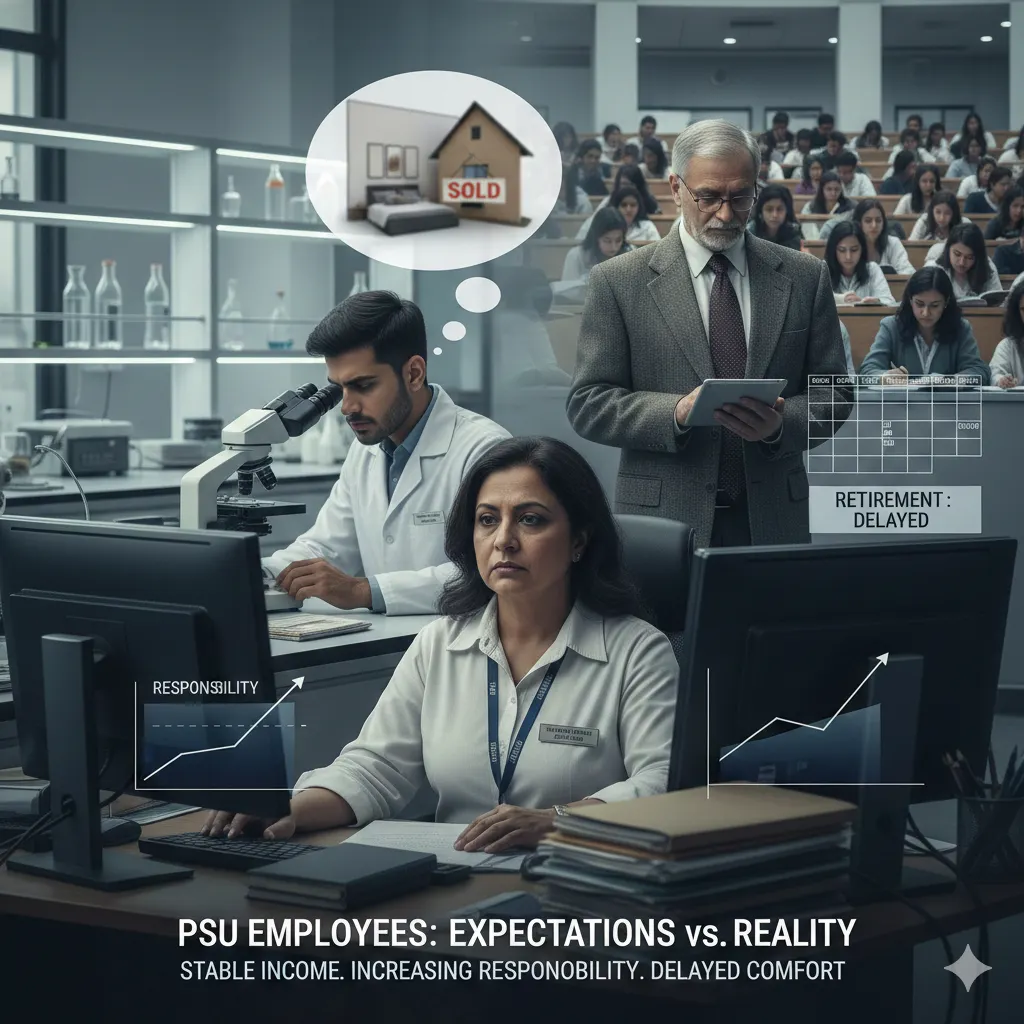
The difference lies not in earnings, but in how expectations evolve compared to reality.
Stability protects income, but it does not automatically preserve monthly ease.
Regular increments improve numbers, but they do not always create space.
Recognising this gap does not require immediate change or correction.
It does not demand action, optimisation, or urgency.
It begins with understanding.
Understanding how financial comfort in PSU life often develops differently than originally imagined.
Understanding that stability and comfort are related, but not identical.
Understanding that this experience is not personal failure, but a natural outcome of long service life.
For many, this recognition itself brings clarity.
It allows the experience to be seen without judgement.
It reduces internal pressure.
It creates space for more grounded conversations around money, career, and long-term balance.
This reflection is not about solutions.
It is about acknowledging a lived reality that many PSU employees carry quietly for years.
Sometimes, awareness does not change circumstances immediately —
but it changes how those circumstances are understood.
And often, that understanding becomes the foundation for calmer, more conscious choices later.
Blog Closing.
This piece is not intended to resolve financial questions or offer direction.
It exists simply to recognise a shared experience within PSU life.
Clarity does not always begin with action.
Sometimes, it begins with seeing clearly.
— Ramjee Meena
Founder, PSUPEDIA