
Why Many PSU Employees Quietly Feel Emotionally Unseen at Work
Why Many PSU Employees Quietly Feel Emotionally Unseen at Work
May 21, 2026

For many PSU employees, professional life slowly becomes emotionally disciplined.
Not emotionally expressive.
Over time, people learn how to control reactions, adjust behaviour, maintain professionalism, and continue functioning calmly inside structured systems.
And honestly, this discipline is one of the reasons PSU organisations continue operating smoothly for decades.
But behind this discipline, many employees quietly carry an emotional experience that rarely gets discussed openly.
The feeling of being professionally responsible… but emotionally unseen.
This feeling usually does not appear suddenly.
It develops slowly across years of hierarchy, formal communication, delayed recognition, and silent adjustment.
In the beginning of career, most employees enter PSU life with sincerity and emotional energy.
A young employee wants to contribute honestly.
Wants to prove capability.
Wants to build professional respect.
At this stage, even small appreciation feels meaningful.
A senior noticing effort.
A simple acknowledgment in a meeting.
A few respectful words after difficult work.
These things create emotional motivation naturally.
1. How Hierarchy Slowly Changes Emotional Behaviour
As years pass, workplace reality slowly changes emotional expectations.
Employees begin understanding that structured organisations are often designed more for operational continuity than emotional understanding.
Processes matter.
Hierarchy matters.
Approvals matter.
Reporting structure matters.
And gradually, emotional acknowledgment becomes secondary.
This is where many PSU employees slowly begin feeling emotionally distant from the workplace itself.
Not because they dislike the organisation.
Not because they stopped caring.
But because sincere effort and emotional recognition do not always move together inside hierarchical systems.
Sometimes work gets appreciated.
Sometimes years of contribution quietly disappear into routine office functioning.
And because PSU culture values endurance, most employees do not openly express disappointment.
They simply continue working silently.
2. The Silent Emotional Fatigue Hidden Behind PSU Discipline
This emotional silence becomes stronger during mid-career life.
Especially after age 35–40, when responsibilities increase both inside office and outside home.
At this stage, the employee is already balancing multiple invisible pressures together.
- family expectations
- children’s future
- aging parents
- transfer uncertainty
- health concerns
- financial responsibilities
- workplace hierarchy
And emotionally, many employees quietly begin carrying a feeling that is difficult to explain clearly.
“Maybe sincere effort alone is not enough to feel emotionally valued here.”
This thought itself slowly creates emotional fatigue.
Not dramatic fatigue.
Quiet fatigue.
The kind that remains hidden behind disciplined office routine.
3. Why Many PSU Employees Feel Professionally Invisible
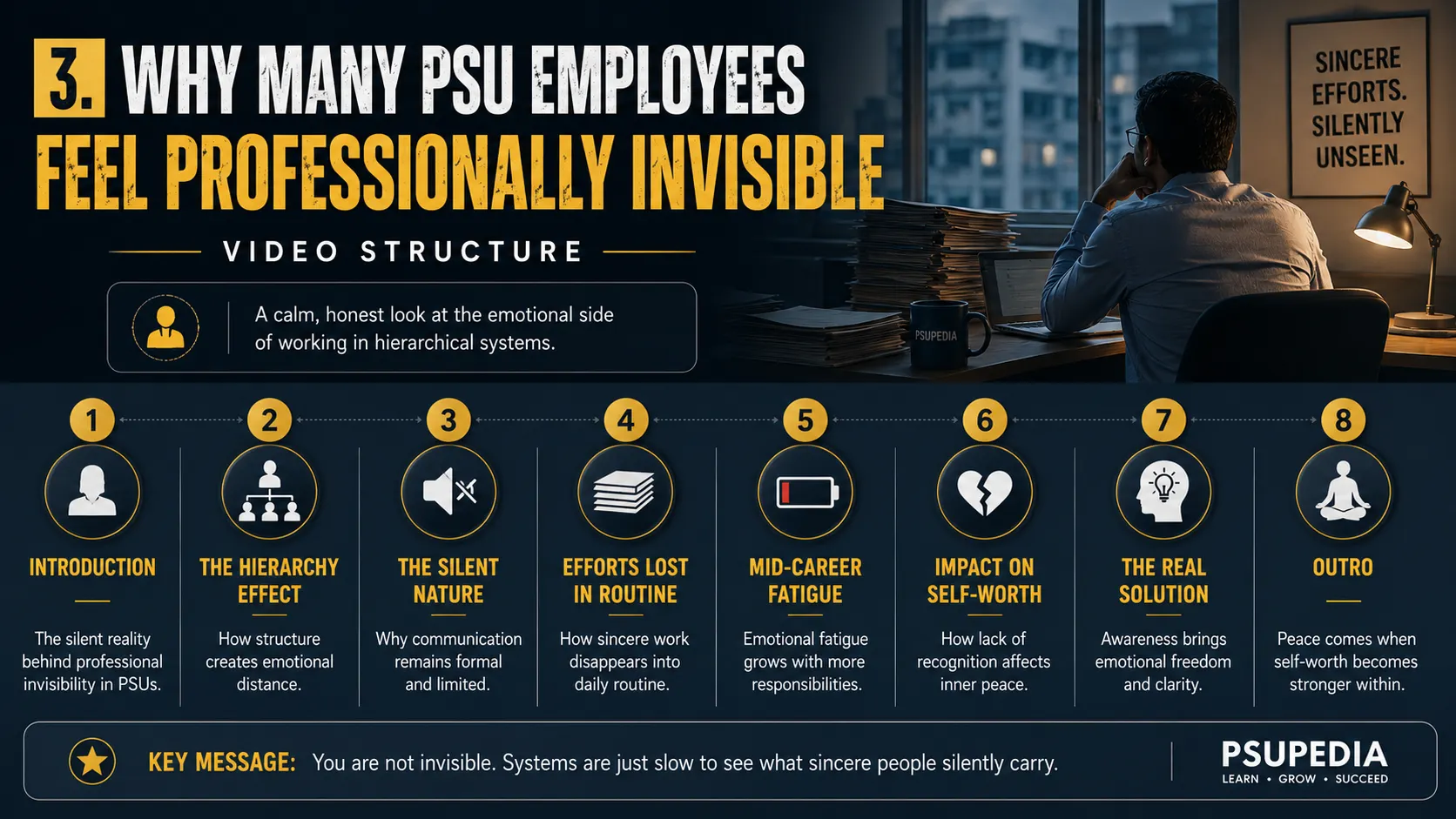
From outside, everything appears stable.
The employee continues attending meetings.
Handling files.
Managing responsibilities.
Following office systems professionally.
But internally, emotional connection with the workplace slowly reduces.
Some employees stop sharing ideas openly.
Some reduce emotional expectations completely.
Some continue working sincerely… but without emotional involvement anymore.
And because this process happens gradually, many people themselves do not notice how emotionally exhausted they have become over time.
This is one of the least discussed psychological realities inside PSU life.
Most conversations remain focused on:
- promotions
- salary structure
- postings
- retirement
- administration
- office politics
Very few conversations explore emotional exhaustion caused by long-term invisibility inside structured systems.
4. When Sincere Effort Stops Feeling Emotionally Valued
Perhaps this emotional invisibility affects peace more deeply than workload itself.
Because human beings do not only need financial stability.
They also need emotional dignity.
Not constant praise.
Not public attention.
Just a quiet feeling that sincere effort matters.
That contribution is emotionally visible somewhere.
But inside highly structured environments, emotional communication often becomes formal, limited, or delayed.
This does not always happen intentionally.
It is simply a side effect of long-term hierarchical culture.
And once employees understand this calmly, many internal conflicts begin making more sense emotionally.
Not every silence means rejection.
Not every lack of appreciation means lack of value.
Sometimes systems themselves struggle to express emotional acknowledgment consistently.
5. Why Workplace Recognition and Self-Worth Become Emotionally Connected
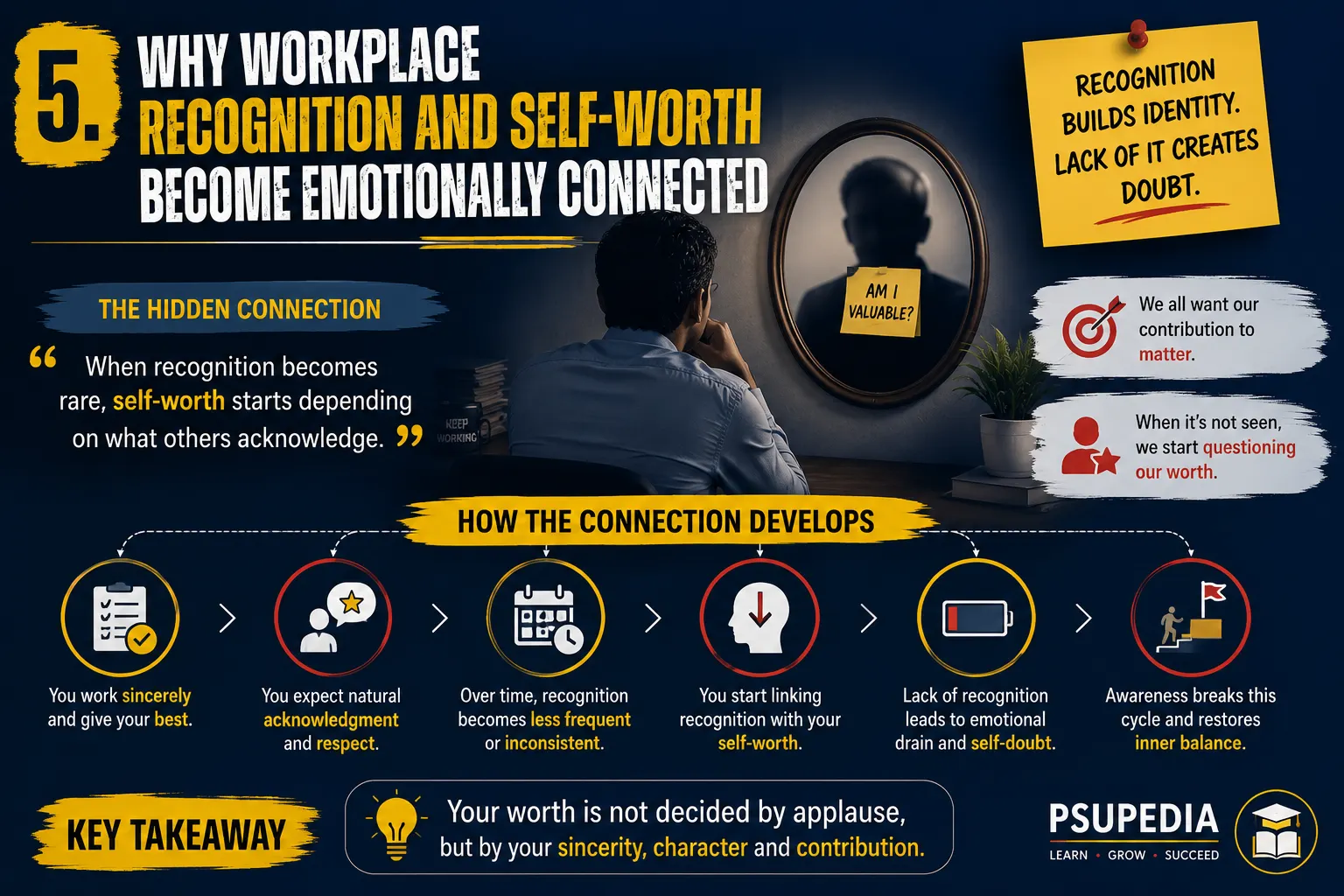
This awareness matters because many PSU employees unknowingly connect workplace recognition directly with self-worth.
And over time, this creates emotional dependence on external validation.
The employee slowly begins feeling valuable only when acknowledged professionally.
But this emotional dependence quietly damages mental peace.
Especially in systems where visibility itself depends heavily on hierarchy and structure.
That is why emotional maturity inside PSU life often begins when employees slowly separate professional structure from personal self-worth.
This understanding does not reduce sincerity.
In fact, it often creates calmer professionalism.
A person continues contributing responsibly… but with healthier emotional expectations internally.
And surprisingly, this awareness preserves emotional energy for years.
Because once a person stops measuring entire self-worth through workplace acknowledgment alone, internal pressure also starts reducing naturally.
6. Real Peace Begins When Self-Worth Stops Depending on Recognition
I have personally observed many PSU employees who were highly capable, deeply sincere, and professionally respected… yet emotionally exhausted internally.
Not because they lacked strength.
But because years of silent emotional invisibility slowly affected peace and mental clarity.
This is why awareness becomes important.
Not emotional reaction.
Not bitterness.
Just awareness.
Awareness that structured workplaces and emotional understanding are not always the same thing.
Awareness that hierarchy often recognises designation faster than emotional contribution.
Awareness that long-term peace requires emotional balance beyond office validation itself.
And perhaps real maturity in PSU life begins when employees stop expecting workplaces to fulfill every emotional need internally.
Because once this understanding becomes clear, emotional exhaustion slowly reduces too.
Not because workplace culture suddenly changes.
But because awareness quietly changes inner interpretation.
A stable career remains valuable.
Professional respect remains important.
But emotional peace begins becoming stronger when self-worth no longer depends entirely on external acknowledgment.
And maybe this is one of the deepest emotional lessons hidden inside long-term PSU life.
Nothing is wrong with you.
You are just becoming more aware.
Outro
Maybe the deepest exhaustion in PSU life is not always workload.
Sometimes… it is the silent feeling of carrying responsibility without feeling emotionally understood for years.
And perhaps many employees slowly become emotionally quiet not because they stopped caring…
but because hierarchy teaches people how to survive professionally while suppressing emotions silently.
But awareness changes something important internally.
A person slowly stops measuring self-worth only through recognition, appreciation, or workplace validation.
And once that awareness enters quietly… emotional pressure also begins reducing naturally.
Not because the system suddenly changes.
But because inner understanding becomes calmer.
A stable career is valuable.
Professional dignity matters deeply.
But long-term peace often begins when emotional balance becomes stronger than emotional dependence on acknowledgment.
This is your host, Ramjee Meena.
I look forward to seeing you in the next video.
And as always, I encourage you to learn, grow, and succeed —
calmly, consciously, and at your own pace.
Nothing is wrong with you.
You are just becoming more aware.