Why PSU Employees Often Miss Early Physical Warning Signs
Why PSU Employees Often Miss Early Physical Warning Signs
Jan 23, 2026
Stable jobs don’t protect physical health. Awareness does.
In PSU life, physical health rarely collapses overnight.
It fades quietly, almost politely.
Most employees don’t remember a single moment when something “went wrong.”
Instead, they remember adjusting.
Adjusting to longer meetings.
Adjusting to irregular meals during site visits.
Adjusting to constant travel between postings.
Adjusting to fatigue and calling it routine.
This is how physical health slowly moves out of focus — not through neglect, but through responsibility.
The Nature of PSU Work.
Public Sector work is built on continuity.
Plants must run without interruption.
Projects must move regardless of personal schedules. Reviews, audits, and inspections arrive on fixed timelines.
Transfers disrupt routines but not expectations.
In such an environment, reliability becomes a personal identity.
Being available matters.
Being stable matters.
Being dependable matters.
And slowly, the body is expected to cooperate with this rhythm.
Early Career: When the Body Cooperates..
In the early years of a PSU career, the body feels resilient.
Long hours do not hurt much.
Standing all day at a site feels manageable.
Late dinners don’t affect sleep significantly.
Recovery is quick, almost automatic.
Because the body adjusts easily, employees rarely pause to observe it.
The absence of discomfort is mistaken for strength.
At this stage, ignoring small signals doesn’t feel risky.
It feels normal.
Mid-Career: When Recovery Changes..
As responsibilities increase, something subtle shifts.
The routines remain mostly the same —
but the body responds differently.
Fatigue lingers longer.
Sleep becomes lighter.
Energy doesn’t fully return after rest.
At the same time, professional pressure increases.
Leadership roles expand.
Accountability grows.
Decisions affect more people.
This overlap — higher responsibility with slower recovery — becomes a critical point.
Yet it often goes unnoticed.
The Internal Normalisation Loop..
Most PSU employees don’t dismiss health concerns consciously.
They explain them away.
“This is normal at my age.”
Everyone in my department feels the same.”
Once this posting ends, things will settle.”
These thoughts are not careless.
They are practical.
When work continues despite discomfort, the mind learns to deprioritise physical signals.
Over time, postponement becomes habit.
Habit becomes normal.
Adjustments, Not Problems..
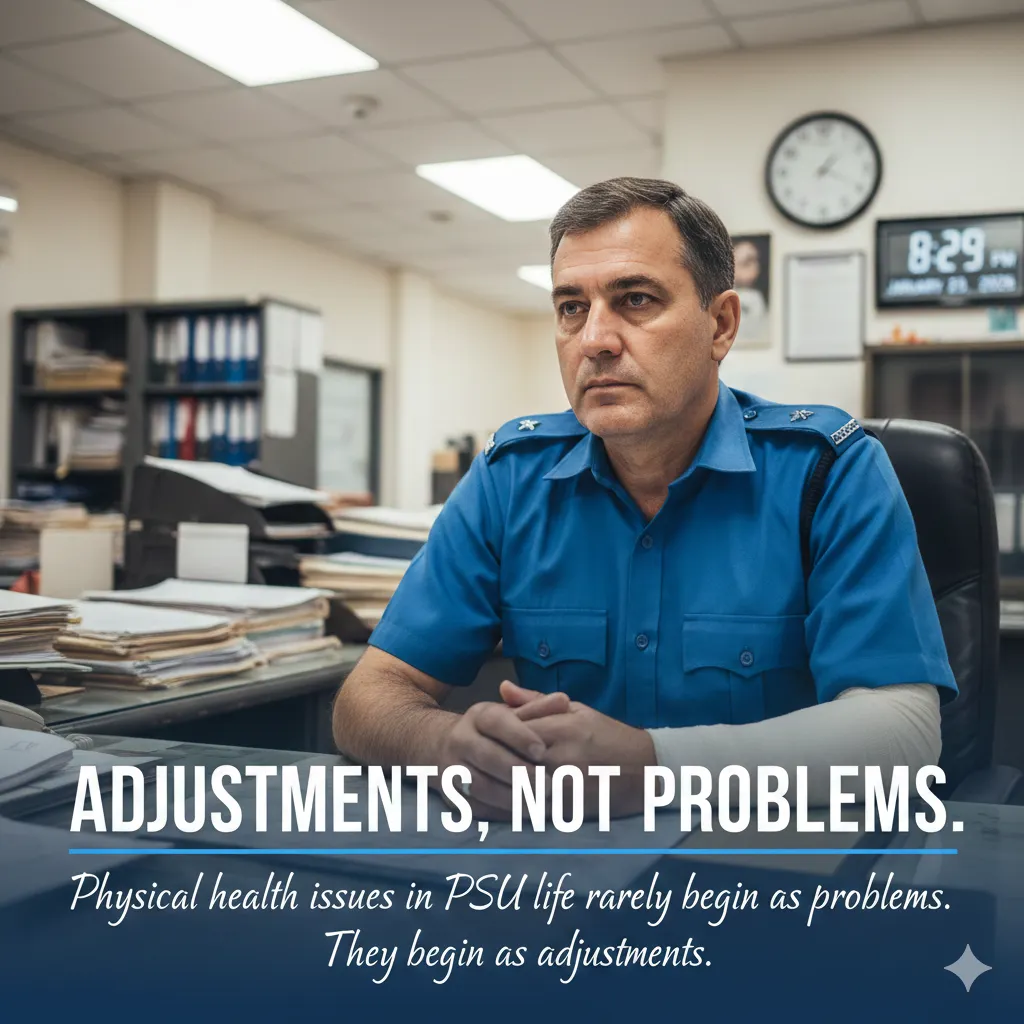
Physical health issues in PSU life rarely begin as problems.
They begin as adjustments.
Skipping meals because meetings ran long. Standing through inspections without breaks.
Sitting for hours in coordination reviews.
Traveling between locations and calling it routine.
The body adapts because it has to.
And because these adaptations do not stop work immediately, they are rarely questioned.
The Quiet Cost of Ignoring Early Signals.
Ignoring early physical signals usually doesn’t result in sudden illness.The cost is quieter.
Energy reduces gradually.
Recovery takes longer.
Stamina drops slightly but consistently.Work still gets done.
But it requires more effort than before.
Over years, this creates a gap between workload and capacity —
a gap that is rarely acknowledged, but often felt.
Why Awareness Comes Late
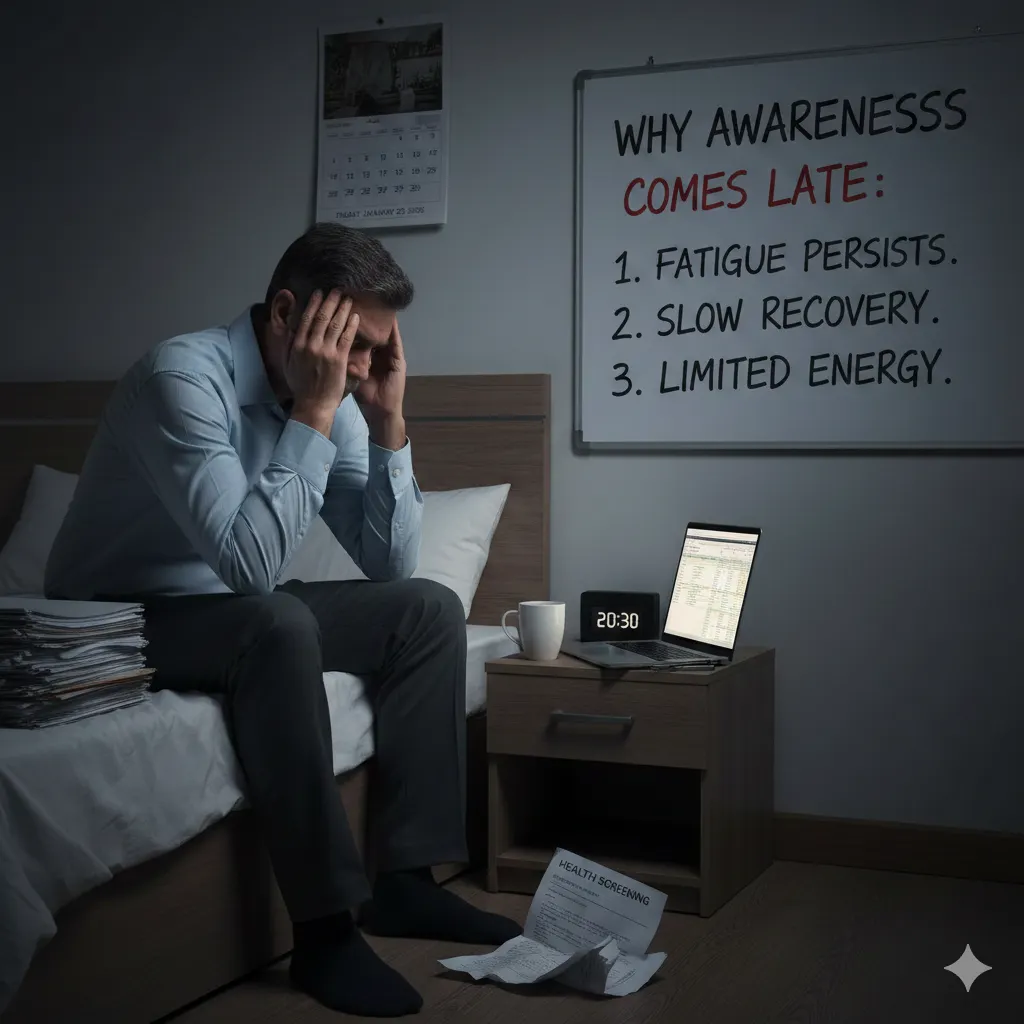
Many PSU employees become aware of their physical health only when:
- Fatigue doesn’t resolve after rest
- Recovery slows noticeably
- Energy feels limited even on lighter days
By then, the body is no longer whispering.
It has already spent years adjusting silently.
This realisation often brings confusion rather than clarity.
“What changed?”
“When did this start?”
The answer is rarely dramatic.
It started with small, postponed signals.
Physical Health Awareness: What It Really Means.
Physical Health Awareness is often misunderstood.
It is not about fitness routines.
It is not about discipline or drastic change.
It is not about comparing oneself to others.
It is simply the ability to notice.
To recognise how long the body has been adjusting.
To acknowledge the imbalance without guilt or panic.
To understand that stability at work does not automatically translate to stability in the body.
Awareness restores balance before disruption becomes unavoidable.
A Shared PSU Reality.
This experience is not individual.
It is collective.
Across departments, locations, and designations, PSU employees share similar patterns:
High awareness of work signals.Low awareness of physical ones.
That imbalance is not a failure.
It is a system-conditioned response.
And recognising it is not weakness.
It is clarity.
Closing Reflection.
Nothing is wrong with you.
If you relate to this experience, it doesn’t mean something has failed.
It means something has been quietly absorbed for years.
The body communicates long before it collapses.
PSU routines often train us to override that communication.
Physical Health Awareness begins when we finally pause —
not to fix, not to change —
but simply to notice.
You are not late.
You are just becoming more aware.
Observe gently.
Freedom does not demand change.
It begins with clarity.
Ramjee Meena
Founder, PSUPEDIA